
E-mail: ncjt@zjncjt.com


When a maintenance engineer pulls a worn lining out of a 1200°C heat-treatment furnace, the first specification checked on the replacement material is its fire rating. The phrase "insulation fire rated" appears on datasheets, purchase orders, and inspection forms, yet it rarely means the same thing in every document.
The short answer: a fire rating for insulation is not a single universal number. It combines standardized fire-test results, including surface flame spread, smoke development, and assembly-level fire resistance, with the material's maximum continuous service temperature. For industrial furnaces operating above 800°C, the insulation must be non-combustible, dimensionally stable at operating temperature, and rated for continuous duty at the furnace's maximum working temperature.
This guide explains how insulation fire ratings work, compares materials that genuinely meet them at high temperature, and walks through the selection, installation, and inspection decisions that keep furnace linings safe through years of thermal cycling.
Content
In building construction, a fire rating describes how a product performs in standardized tests. In industrial furnace design, the same term carries an extra layer: the rating must also guarantee survival at the operating temperature of the equipment. Understanding both layers prevents costly mis-selection.
Fire-rated insulation is evaluated on three distinct behaviors:
A Class A flame-spread rating does not tell you whether a material can survive 1000°C. Polyurethane foam can be formulated to meet Class A surface burning characteristics, yet its continuous service temperature stays near 90 to 120°C. Ceramic fiber, by contrast, is non-combustible by nature and routinely serves at continuous temperatures of 1260°C and above. For furnace linings, the operating-temperature rating matters every bit as much as the fire classification.
The table below compares the materials most commonly offered as fire-rated insulation.
The practical takeaway: for any furnace, kiln, or reactor operating above 800°C, the ceramic fiber and refractory options in the top four rows are the only realistic choices. The remaining materials are excluded by temperature alone, regardless of their fire classification. To understand the performance differences in more depth, see our complete buyer's guide to high-temperature insulation materials.
Four test standards appear repeatedly on insulation datasheets and furnace specifications. Knowing what each one measures prevents the common mistake of reading "Class A" as a guarantee of high-temperature performance.
The Steiner tunnel test measures flame spread and smoke development on a sample about 7.6 meters long. Class A requires a flame spread index of 0 to 25 and a smoke developed index below 450. Most ceramic fiber and mineral wool products meet this comfortably because they contain no significant combustible binder.
This test exposes a small specimen to roughly 750°C and checks whether it ignites, releases heat, or loses mass beyond defined limits. Non-combustible materials, including ceramic fiber and insulating fire brick, pass without chemical flame retardants.
Unlike E84, which tests a material surface, E119 tests a complete wall, floor, or furnace lining system. Results are expressed in hours, such as 1-hour or 2-hour ratings. For furnace builders, this test certifies the whole lining design, not just the insulation layer.
European projects use Euroclass A1 and A2 for non-combustible or limited-combustible products, followed by classes B through F for increasingly combustible materials. High-temperature ceramic fiber products typically achieve A1 classification.
Two insulation materials can carry the same fire classification but differ enormously in furnace performance. Three hidden metrics matter most.
Ceramic fiber is an excellent insulator at 400°C, but its thermal conductivity increases as the mean temperature climbs. At 1000°C, a 50 mm layer of standard ceramic fiber conducts noticeably more heat than at 500°C. That is why lining engineers specify thickness based on operating temperature, not fire classification alone.
Dense refractories store large amounts of heat. A lightweight ceramic fiber lining stores a fraction of the heat of a dense firebrick wall, which translates into faster heat-up, faster cool-down, and measurable energy savings in batch furnaces. The trade-off is mechanical: fiber linings cannot support heavy loads, so hearths and load zones still need brick or castable.
Rapid thermal cycling cracks dense materials. Ceramic fiber accommodates expansion and contraction without cracking, making it the default choice for furnaces that cycle between ambient and operating temperature daily.
Maximum continuous service temperature of common insulation materials (representative values):
Fire-rated insulation protects the furnace shell from distortion, operators from radiant heat, and the product from uncontrolled temperature gradients. Three lining zones demand different materials.
The inner layer of a furnace lining faces direct radiant heat and, in some designs, direct flame impingement. Non-combustible ceramic fiber blanket for furnace lining is the most common hot-face choice for 1200-1400°C furnaces. Module layout, compression, and anchoring details are covered in our ceramic fiber blanket furnace lining guide.
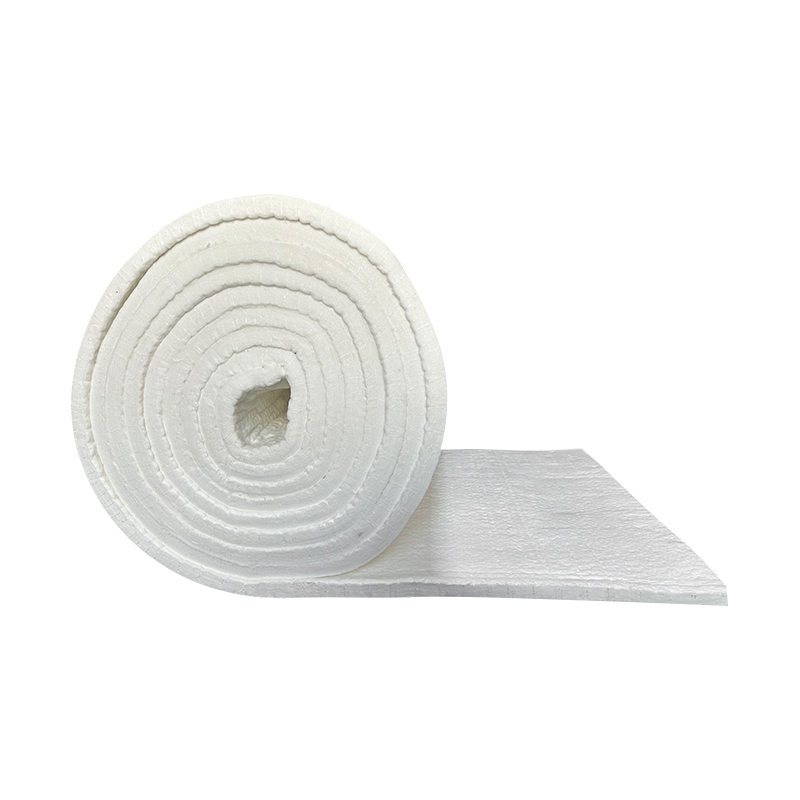 Ceramic Fiber Blankets Manufacturers, Factory - Zhejiang Nengcheng Crystal FiberNengcheng is China Ceramic Fiber Blankets Manufacturers and Factory, Custom Ceramic Fiber Blankets for sale, Introduction The NC ceramic ...View Product →
Behind the hot face, a second layer reduces heat loss and keeps the outer shell at a safe temperature. Nano microporous insulation board delivers very low thermal conductivity in a thin profile, which is valuable when furnace dimensions are tight or when the shell temperature limit is strict.
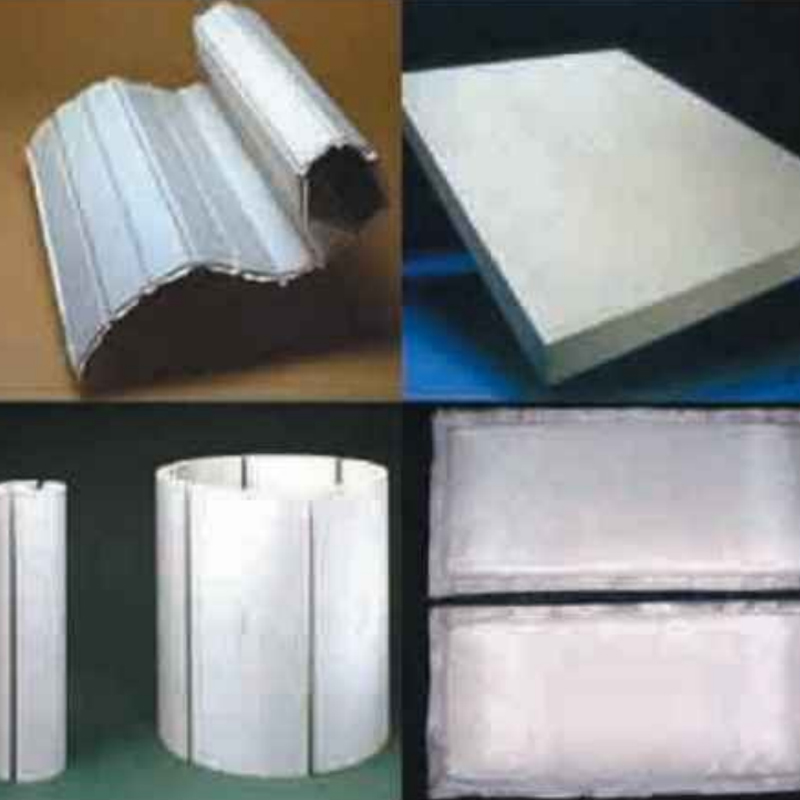 Nano Microporous Insulation Board Manufacturers, Factory - Zhejiang Nengcheng CrNengcheng is China Nano Microporous Insulation Board Manufacturers and Factory, Custom Nano Microporous Insulation Board for sale, Nano-i...View Product →
Where furnace loads rest directly on the insulation, fiber alone is not enough. Lightweight insulating fire bricks combine moderate strength with low thermal mass, making them suitable for hearths, burner surrounds, and structural details that must not crush under load. The insulating fire brick types and grades guide explains how to match the grade to the temperature zone.
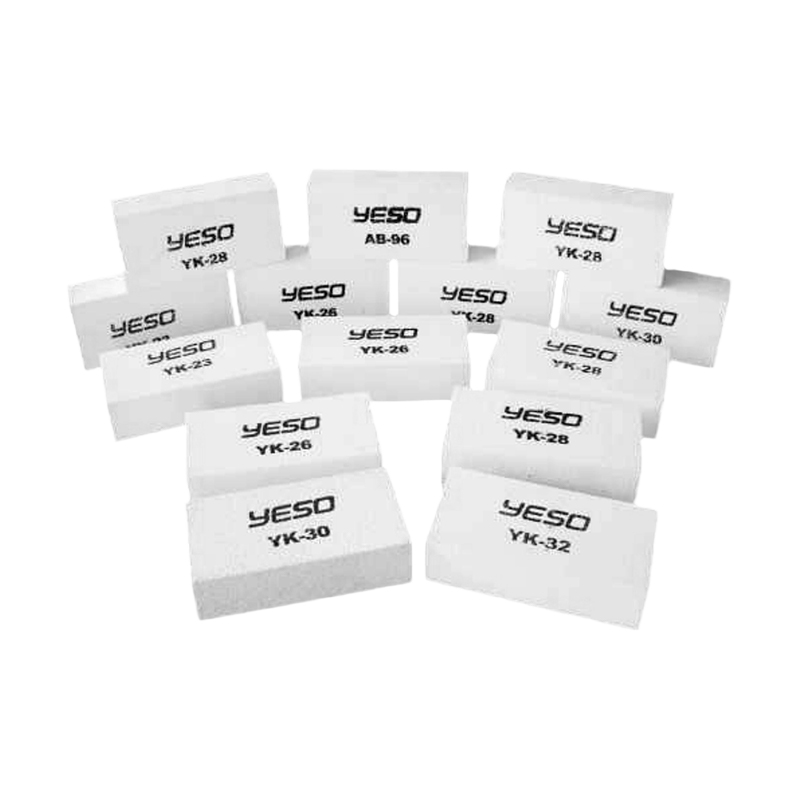 Lightweight Insulating Fire Bricks Manufacturers, Factory - Zhejiang Nengcheng CNengcheng is China Lightweight Insulating Fire Bricks Manufacturers and Factory, Custom Lightweight Insulating Fire Bricks for sale, Ligh...View Product →
Demand for fire-rated high-temperature insulation comes mainly from industries operating continuous or batch furnaces. The distribution below reflects typical purchasing patterns in furnace engineering and refractory supply.
Illustrative distribution based on typical demand across sectors served by industrial furnace and refractory suppliers.
For metal heat-treatment shops, the priority is usually a lining that survives repeated thermal cycling while keeping shell temperatures safe. For ceramics and electronics, temperature uniformity and clean operation matter more. Knowing the dominant demand in your sector helps narrow material choices.
The selection process can be compressed into five steps. Following them in order avoids the two most common mistakes: choosing a material that passes the fire test but fails at operating temperature, and choosing a material that withstands the temperature but cannot handle the mechanical duty.
Step 1: Define maximum continuous operating temperature. Add a safety margin of 50-100°C above the highest normal operating temperature.
Step 2: Identify the furnace atmosphere. Oxidizing, reducing, or vacuum atmospheres each impose different constraints on fiber purity and binder selection.
Step 3: Assess mechanical loads. Hearth, burner, and support zones need rigid materials such as insulating fire brick; walls and roofs can use fiber blanket or modular board.
Step 4: Compare thermal conductivity and heat storage. Use datasheet values at the actual mean temperature, not room-temperature data.
Step 5: Verify documentation. Confirm fire classification, temperature rating, and test certificates before purchase, and keep them in the equipment file.
A fire-rated lining is only as good as its condition. Even non-combustible insulation degrades over time, and degradation changes both thermal performance and fire safety.
Fire-rated insulation is not a single product category but the result of verified material properties and proper engineering. For high-temperature furnace service, that combination comes down to non-combustible ceramic fiber and refractory insulation, correctly selected, installed, and maintained.
Introduction: Aluminum silicate fiberboard material is currently a high-performance insulation material. Aluminum silicate fiberboard has excellent properties such as light w...
Introduction: Aluminum silicate refractory fiber products are made by selective processing of pyroxene, high-temperature melting, blow molding into fibers, solidification mol...
Introduction: 1、 Shaped ceramic fiber furnace lining for high alumina ceramic fiber board The shaped ceramic fiber furnace lining of high alumina ceramic fiber board mai...

An enterprise integrating design, R&D, production, sales and engineering services. Ceramic Fiber Board Manufacturers, Vacuum Heat Treatment Solutions in China
Phone: +86-13967261180
+86-17858398898
Email: ncjt@zjncjt.com
Arlen@zjncjt.com
Tel: +86-572-8295956
Add: Wulintou, Tangbei Village, Leidian Town, Deqing Country, Huzhou City, Zhejiang Province, China
Copyright © 2024 Zhejiang Nengcheng Crystal Fiber Co., Ltd. All Rights Reserved.

 English
 Español
 عربى
عربى