
E-mail: ncjt@zjncjt.com


Content
For decades, industrial facilities have relied on dense refractory bricks and castable linings to manage high-temperature environments in kilns, boilers, and industrial furnaces. While these materials offer compressive strength, they also carry significant drawbacks: high thermal mass, slow heat-up and cool-down cycles, heavy installation labor, and susceptibility to cracking under thermal cycling. The ceramic fiber blanket has fundamentally changed how engineers approach thermal management in demanding environments, particularly for furnace lining insulation applications where energy efficiency, installation speed, and long-term reliability are all priorities.
Unlike brick-based systems that absorb and store heat in the furnace wall itself, a ceramic fiber blanket works as a low-mass insulator that reflects and resists heat transfer rather than absorbing it. The result is faster furnace heat-up times, lower fuel consumption, and reduced thermal stress on the structural shell — outcomes that translate directly into measurable cost savings over the equipment's operational life. As industries continue to optimize for energy efficiency and reduced maintenance downtime, the ceramic fiber blanket has become the go-to solution for both new construction and retrofit lining projects.
Not all ceramic fiber blankets are manufactured to the same standard. The NC ceramic fiber blanket is produced from high-quality ceramic fiber using a specialized double needle-punching processing technique that sets it apart from conventionally manufactured alternatives. In standard fiber blanket production, fibers are layered and lightly bonded, which can leave them prone to delamination — splitting between layers — when subjected to vibration, mechanical handling, or the rapid thermal expansion forces present inside an operating furnace.
The double needle-punching technique mechanically interlocks fibers across multiple planes within the blanket body. Each pass of the needle-punching process drives fibers from upper layers through lower layers and back, dramatically increasing the degree of fiber intertexture. This three-dimensional fiber matrix produces a blanket with significantly enhanced delamination resistance and tensile strength compared to single-needle or unbonded alternatives. In practical terms, the blanket holds its form and structural integrity during installation around curves, edges, and irregular surfaces — and maintains that integrity throughout years of thermal cycling inside a furnace lining system.
Critically, the NC ceramic fiber blanket contains no bonding agent. Many competing products use chemical binders to hold fibers together, but these binders can burn off at elevated temperatures, releasing fumes and leaving behind a weakened structure. The binder-free construction of the NC blanket means its mechanical and thermal properties are determined entirely by the fiber structure itself — properties that remain fully stable even after repeated exposure to oil, water, or steam.
The suitability of any material for furnace lining insulation is defined by a precise set of performance characteristics. The NC ceramic fiber blanket delivers on every key metric that engineers and plant managers look for when specifying a lining system. The table below summarizes its principal properties:
| Property | Performance Detail |
| Thermal Conductivity | Low — minimizes heat transfer through the furnace wall |
| Heat-Shock Resistance | Excellent — withstands rapid temperature fluctuations without cracking |
| Chemical Stability | Resistant to most chemical erosion; stable in oil, water, and steam |
| Tensile Strength | Enhanced by double needle-punching; resists tearing during installation |
| Delamination Resistance | High — fiber intertexture prevents layer separation |
| Flammability | Nonflammable |
| Springiness / Elasticity | Good — conforms to irregular surfaces and recovers after compression |
| Soundproofing | Effective — absorbs mechanical vibration and airborne noise |
| Bonding Agent | None — binder-free construction ensures stable high-temp performance |
The combination of low thermal conductivity, excellent heat-shock resistance, and stable chemical performance makes the NC ceramic fiber blanket one of the most comprehensively qualified materials available for furnace lining insulation. Its nonflammable character and springiness further ensure that the lining system remains safe and dimensionally consistent even as the furnace structure expands and contracts through operational temperature cycles.
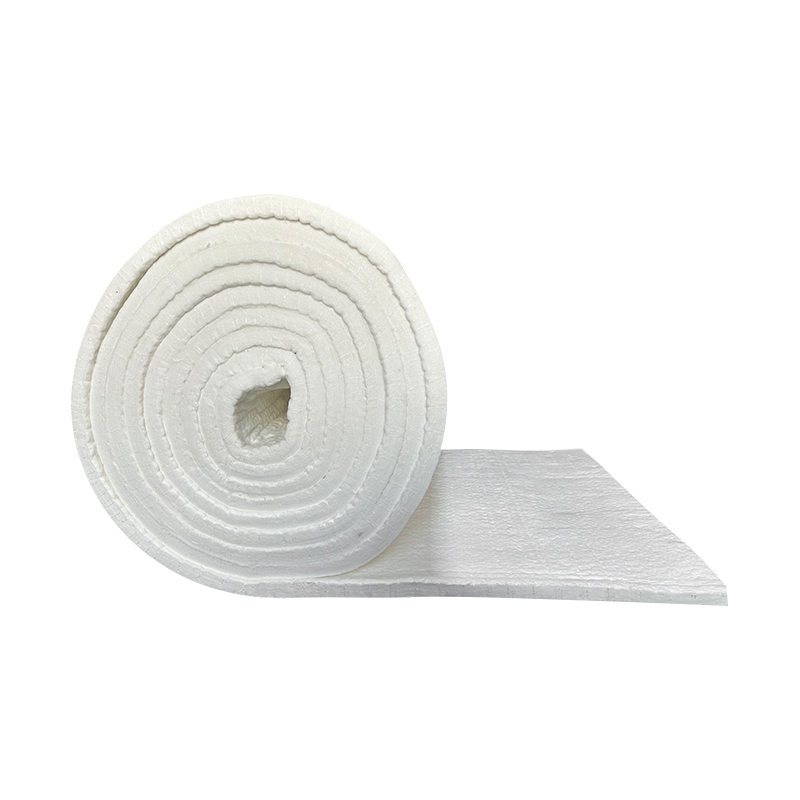
The most demanding and most common use of ceramic fiber blanket is in industrial furnace lining insulation, where the material is applied to both internal and external surfaces of the furnace structure. Each position serves a distinct thermal engineering purpose and requires the blanket to perform under different load conditions.
When used as the internal lining of an industrial furnace, the ceramic fiber blanket forms the hot face of the insulation system — the surface directly exposed to the furnace atmosphere and process temperatures. In this position, the blanket must simultaneously reflect radiant heat back into the working chamber, resist chemical attack from combustion gases or process atmospheres, and maintain its structural form without shrinking, cracking, or eroding. The NC blanket's excellent chemical stability and resistance to erosion from most industrial chemicals make it well-suited to these conditions. Its binder-free fiber matrix does not outgas or degrade when exposed to the flame environment, maintaining consistent insulating efficiency throughout the campaign life of the furnace.
As an external lining or backup insulation layer behind a harder hot-face material, the ceramic fiber blanket reduces heat transmission to the furnace shell, protecting structural steel from thermal stress and keeping exterior surface temperatures within safe working limits. In this role, the blanket's low thermal conductivity is the primary performance driver. Thicker blanket configurations or multiple stacked layers are commonly used to achieve target shell temperatures in furnaces operating at higher process temperatures. The blanket's springiness also plays a practical role here: it compensates for differential thermal expansion between the rigid furnace shell and the internal lining layers, acting as a compliant cushion that prevents stress cracking at interfaces.
While furnace lining insulation represents the most technically demanding application, the NC ceramic fiber blanket's property profile makes it equally valuable across a wide range of other industrial and specialist uses:
Achieving the full performance potential of a ceramic fiber blanket in furnace lining insulation depends on correct product selection and careful installation practice. The following factors should guide the specification process:
When correctly specified and installed, the NC ceramic fiber blanket delivers a furnace lining insulation system that reduces energy consumption, extends equipment life, and minimizes maintenance intervention — making it one of the most cost-effective thermal management investments available for industrial heating applications.
Introduction: Aluminum silicate fiberboard material is currently a high-performance insulation material. Aluminum silicate fiberboard has excellent properties such as light w...
Introduction: Aluminum silicate refractory fiber products are made by selective processing of pyroxene, high-temperature melting, blow molding into fibers, solidification mol...
Introduction: 1、 Shaped ceramic fiber furnace lining for high alumina ceramic fiber board The shaped ceramic fiber furnace lining of high alumina ceramic fiber board mai...

An enterprise integrating design, R&D, production, sales and engineering services. Ceramic Fiber Board Manufacturers, Vacuum Heat Treatment Solutions in China
Phone: +86-13967261180
+86-17858398898
Email: ncjt@zjncjt.com
Arlen@zjncjt.com
Tel: +86-572-8295956
Add: Wulintou, Tangbei Village, Leidian Town, Deqing Country, Huzhou City, Zhejiang Province, China
Copyright © 2024 Zhejiang Nengcheng Crystal Fiber Co., Ltd. All Rights Reserved.

 English
 Español
 عربى
عربى