
E-mail: ncjt@zjncjt.com


A furnace lining rarely fails because the brick was "not high alumina enough". It fails because the grade was picked from a label instead of a data sheet. We regularly see 1,400 °C heat-treatment furnaces lined with a 55% alumina brick that spalls within a year, while a nearby 1,600 °C kiln runs a similar class of material for six years. The difference is usually load, atmosphere, and joint design, not the pallet label.
So here is the conclusion first: "high alumina refractory" describes a family with an Al₂O₃ content anywhere from about 45% to above 90%, and inside that band the refractoriness under load, bulk density, and thermal-shock resistance can differ by a factor of three or more. Two bricks with the same nominal alumina content can behave like different materials. Selection has to start from the hot-face temperature, the mechanical load, and the chemical environment, then work backwards to alumina content, bond type, and lining architecture.
Key takeaway before you read further
Content
The common industry definition is simple: a refractory becomes "high alumina" once its Al₂O₃ content exceeds 45%. Below that, it is classed as fireclay; above roughly 90%, it is a corundum refractory. The mineralogy explains the behaviour. As alumina rises, the microstructure shifts from a silica-rich glassy matrix with dispersed mullite, to a mullite–corundum structure, and finally to a corundum-dominated body with very little glassy phase left.
That shift buys higher refractoriness, better slag and alkali resistance, and higher hot strength. It also brings higher density, higher thermal conductivity, and, in the top grades, noticeably weaker thermal-shock resistance. A 90% corundum brick that survives years in a steel ladle can crack after three thermal cycles in a batch furnace door. Alumina content is a filter, not an answer.
One thing the table cannot show is the lining behind the working face. A dense high alumina hot face protects the shell from heat, abrasion and slag, but it is also the worst insulator in the wall. Most efficient furnaces pair a working layer with one or two insulating layers, and that is where lightweight high alumina insulating fire brick (typically 0.6–1.0 g/cm³, roughly 0.25–0.4 W/m·K at 800 °C) does the heavy lifting without carrying structural load.
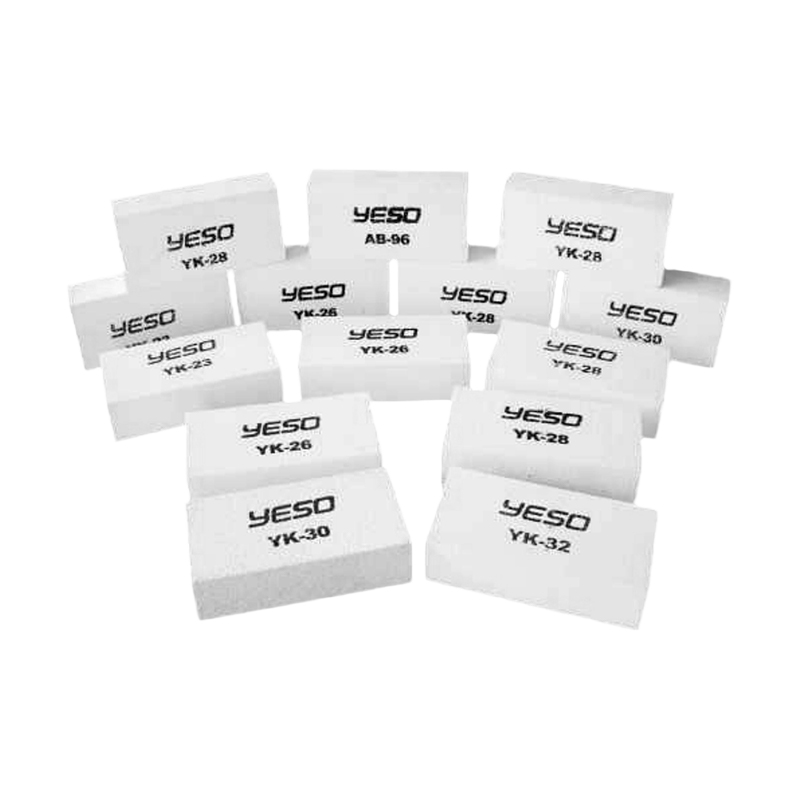 Lightweight High Alumina Insulating Fire BricksFor insulating layers behind the hot face, compare these lightweight fire brick grades by density, alumina content, and thermal conductivity.View Product →
Specification sheets are long, but only a handful of values actually correlate with field performance. These are the ones worth arguing about in a technical review.
The temperature at which a sample deforms 0.5% under 0.2 MPa. A brick rated to 1,750 °C refractoriness may still slump at 1,450 °C when it is carrying its own weight plus arch or roof load.
Dense high alumina brick usually runs 2.4–3.0 g/cm³ with 15–22% apparent porosity. Low porosity slows slag penetration but raises conductivity and thermal stress.
Often 40–80 MPa for fired high alumina brick. It governs transport damage, handling loss and resistance to abrasive charge contact, and a 30% spread between suppliers is common.
Reported as water-quench cycles. Medium alumina grades tolerate more cycles than corundum; batch furnaces, doors and ladle lids live or die on this value.
Hot modulus of rupture at 1,400 °C and creep rate over a long hold describe slow deformation. Where furnaces run continuously for months, creep, not melting, ends the campaign.
Free silica, alkali and iron oxide in the raw material create a glassy phase that lowers RUL. Ask for the chemical analysis, not only the alumina figure.
Wall heat loss is a quieter cost than a brick failure, and it is the easiest one to model before purchase. The chart below compares indicative wall heat flux for five lining builds with the same 1,100 °C hot face and 60 °C ambient, expressed in W/m² of wall area.
The interesting part is not the first bar but the last two. Moving from a brick-and-blanket wall to a layered build with high alumina ceramic fiber board and a microporous backing typically cuts wall loss by half again, and the incremental material cost is a fraction of the working-layer budget. If you want to understand how board structure itself is engineered for that duty, this breakdown of high alumina ceramic fiber board structure is worth reading alongside your lining drawing.
 Alumina Ceramic Fiber Board for Furnace LiningsUse this board where a layered furnace wall needs direct-flame resistance, low thermal conductivity, and a grade suited to the hot face.View Product →
Consumption concentrates wherever temperature, mechanical load and chemistry combine. The split below is an indicative view of global high alumina demand by industry, useful mainly for judging which failure modes matter most in your segment.
Working through these steps in order takes perhaps an hour and prevents the expensive kind of rework, because every later decision depends on the earlier ones.
The payback arithmetic is straightforward. Take a 30 m² furnace wall running 6,000 hours a year. Cutting wall flux by 350 W/m² saves 10.5 kW, or about 63,000 kWh annually, which at 0.10 per kWh is roughly 6,300 per year. That is usually more than the price difference between an average and an optimized insulation stack, and it repeats every year of the campaign.
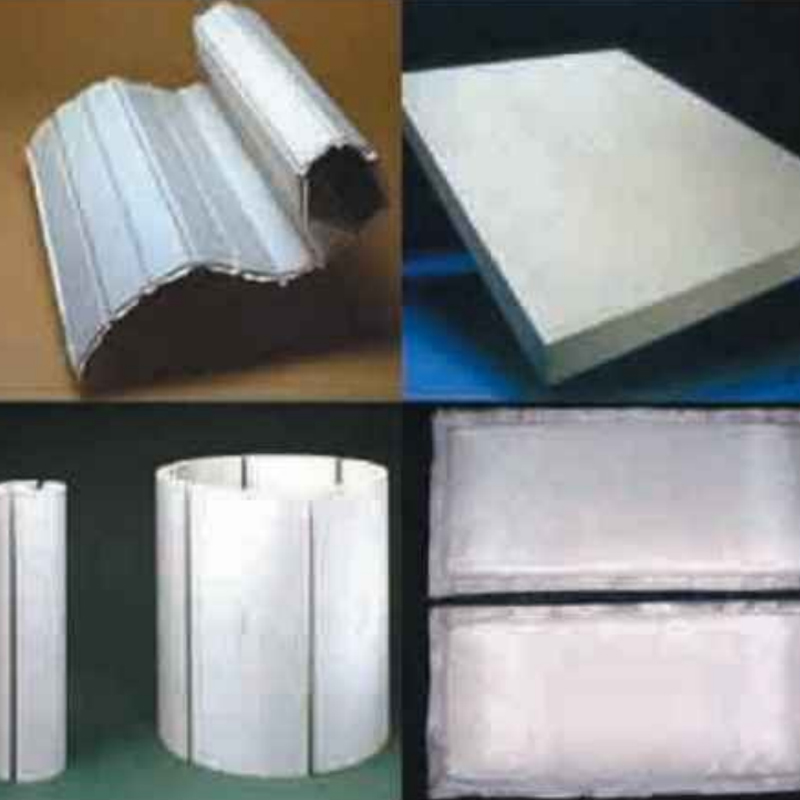 Nano Microporous Insulation Board for High-Temperature FurnacesThis board suits optimized insulation stacks where very low thermal conductivity and low heat storage improve payback on high-temperature furnace walls.View Product →
A high alumina lining is a consumable, and its remaining life can be tracked rather than guessed. A few habits make the difference between planned replacement and an unplanned shutdown.
If you are reviewing an existing lining drawing or planning a furnace upgrade, our technical support team can review hot-face data, interface temperatures and material selection before the specification is frozen.
High alumina refractory is not a single product you can specify with one number. It is a family that runs from 45% to over 90% Al₂O₃, and the performance differences inside that range are larger than the differences between high alumina and fireclay. Choose the grade from hot-face temperature, load and chemistry, verify it with batch-specific RUL and porosity data, and treat insulation as an investment with a computable return rather than an optional extra. Done in that order, most lining failures become predictable events instead of surprises.
Introduction: Aluminum silicate fiberboard material is currently a high-performance insulation material. Aluminum silicate fiberboard has excellent properties such as light w...
Introduction: Aluminum silicate refractory fiber products are made by selective processing of pyroxene, high-temperature melting, blow molding into fibers, solidification mol...
Introduction: 1、 Shaped ceramic fiber furnace lining for high alumina ceramic fiber board The shaped ceramic fiber furnace lining of high alumina ceramic fiber board mai...

An enterprise integrating design, R&D, production, sales and engineering services. Ceramic Fiber Board Manufacturers, Vacuum Heat Treatment Solutions in China
Phone: +86-13967261180
+86-17858398898
Email: ncjt@zjncjt.com
Arlen@zjncjt.com
Tel: +86-572-8295956
Add: Wulintou, Tangbei Village, Leidian Town, Deqing Country, Huzhou City, Zhejiang Province, China
Copyright © 2024 Zhejiang Nengcheng Crystal Fiber Co., Ltd. All Rights Reserved.

 English
 Español
 عربى
عربى