
E-mail: ncjt@zjncjt.com


A 1200 °C batch sintering furnace in a ceramics plant lost its roof lining after eight months. The fibre module was not defective; it had been specified right at its grade limit and installed at 60 mm over an anchorage that saw a full heating cycle every week. Replacing the lining cost roughly what the original did. The three weeks of lost firing did not.
That pattern sits behind most refractory problems. Refractory materials are bought on price per tonne or per square metre, but they are paid for in uptime, energy and scrap rate. The practical conclusion: fix four numbers before anyone quotes a price — continuous service temperature, atmosphere and slag chemistry, thermal cycling frequency, and mechanical load. Then compare suppliers on cost per year of service rather than cost per tonne.
Content
The working definition is functional rather than chemical: a refractory is a non-metallic material that keeps its shape and its performance above about 1000 °C. Supplier catalogues usually split the field into shaped products (bricks), unshaped or monolithic products (castables, ramming mixes, gunning mixes, mortars), fibre products, and functional refractories such as nozzles and flow-control parts. What matters for a specification is that six properties pull against each other.
A fireclay brick rated 1400 °C can still deform at 1300 °C under a roof load, so the load-softening figure matters more than the headline maximum.
Cycling builds crack networks. Silica brick tolerates very high temperature but almost no rapid cycling; fibre and insulating brick tolerate cycling but not abrasion.
Alkali vapour destroys high-alumina linings from the hot face inward. Basic slag needs magnesia, acidic slag needs silica. Atmosphere belongs in the specification.
Charge impact, dust-laden gas and slag carry-over demand density. Fibre hot faces need a coating or a hard face wherever the burden touches them.
Steady-state shell loss and cyclic heat storage are different problems; in batch furnaces the second one usually dominates the energy bill.
In sapphire, electronic and vacuum work, binder and iron content can contaminate the product more expensively than the whole lining cost.
The table below condenses typical published ranges for the families most often quoted on 1000–1700 °C furnace projects. Treat the numbers as a screening tool and confirm the final choice against the supplier's data sheet for the exact grade.
 Ceramic Fiber Modules for High-Temperature Furnace LiningsAnchored ceramic fiber modules suit 1260–1600 °C furnace linings and can help reduce cycle energy versus dense fireclay walls.View Product →
Two linings can show the same shell temperature and still use very different amounts of energy, because a batch furnace pays for the heat it stores in the wall on every cycle. The chart below uses an indexed comparison — a dense fireclay wall set at 100 — of cycle energy for equal hot-face area and equal shell loss. The indices are illustrative, but the ranking holds across most 1000–1300 °C batch equipment.
Hidden metrics move the index further than most buyers expect: hot-face emissivity, joint tightness, anchor thermal bridging, air infiltration through an unsealed fibre surface in high-velocity ducts, and residual moisture after commissioning. A 2 % air leak around a door frame can cost more than the difference between two brick grades. If you want the long-form version of this comparison, our thermal insulation buyer's guide sets out the same trade-offs material by material.
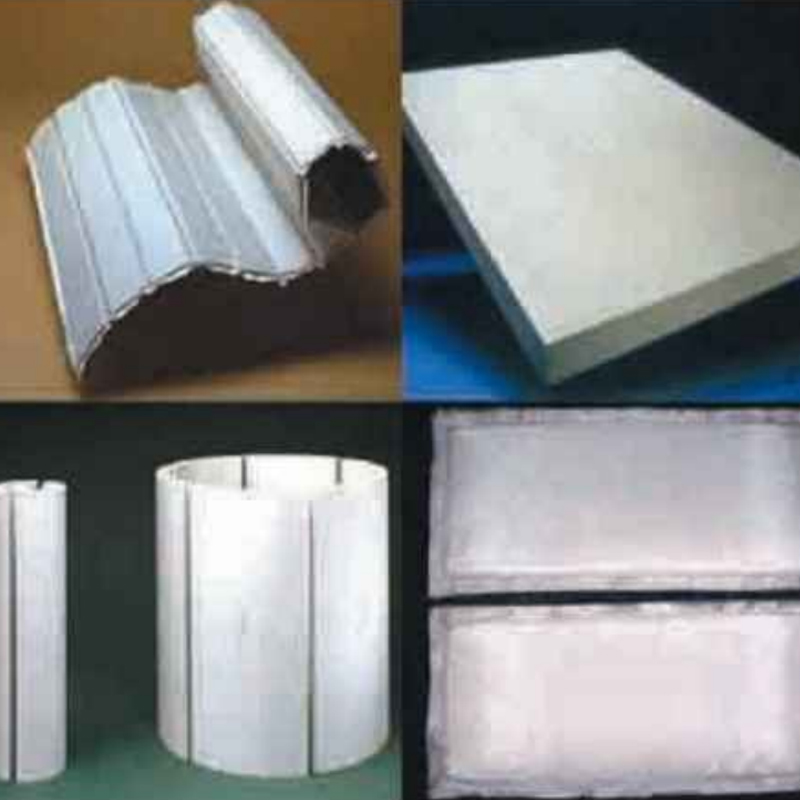 Nano Microporous Insulation Board for High-Efficiency Thermal BarriersA 1000 °C microporous board with low thermal conductivity and low heat storage for high-efficiency industrial furnace insulation.View Product →
Order mix tells you which failure modes a supplier actually sees in the field. The distribution below reflects a typical mid-size furnace and material supplier's mix across ceramics, metal treatment, glass, electronics, chemical and laboratory work.
The practical reading: most volume sits where continuous service temperature is moderate but cycling is frequent, which is exactly where fibre-based linings and insulating firebrick earn their place. The smaller electronics and laboratory slice is where high-purity polycrystalline fibre, dense corundum and controlled-atmosphere hardware matter disproportionately.
Use the maximum continuous value plus a margin for overshoot, not the set point. A 1200 °C set point with a 60 °C overshoot needs a 1300 °C grade.
Air, nitrogen, hydrogen, vacuum and alkali vapour eliminate different families. Vacuum work also rules out binders that outgas.
Three cycles a week justifies a low-storage lining; a furnace held at temperature for eleven months does not.
Anchor grade, spacing and expansion joints decide whether a good material survives. Ask for the anchorage drawing, not just the material data sheet.
Castables fail on the first heat-up far more often than in service. A written ramp with holds at 150, 350 and 600 °C is part of the purchase.
Price per square metre divided by expected campaigns, plus energy per cycle, plus installation labour. That is the number the finance team will ask for.
Take a 1 m³ batch chamber at 1200 °C running three cycles a week. A 100 mm fireclay hot face backed with 150 mm of insulation stores roughly four to five times the heat of a 200 mm ceramic fibre module wall of the same area. That stored heat is paid for at every cycle, whether or not the useful load changes.
In practice, moving a batch furnace from dense brick to a module-based lining typically cuts 15–25 % of cycle energy and shortens heat-up by 20–40 minutes. On three cycles a week, that usually pays the lining premium back inside one to three years — faster if the shorter cycle adds a productive run per week. For continuous furnaces the arithmetic shifts: steady-state shell loss dominates, so back-up boards and sealed joints matter more than storage.
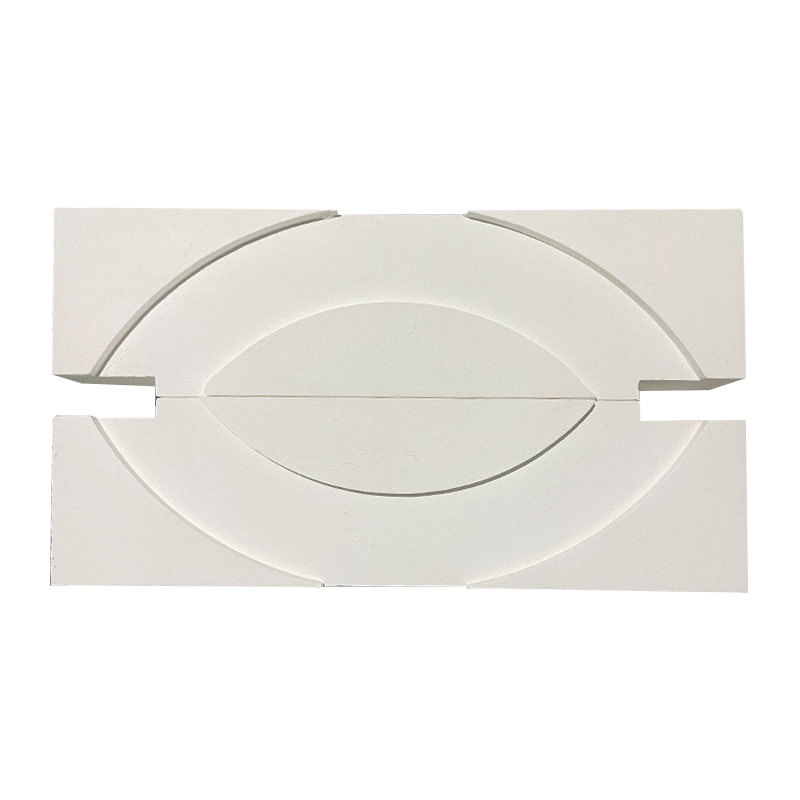 Custom Ceramic Fiber Special Shaped Refractory PartsDrawing-based fiber shapes for burner bricks, observation holes and element supports, available in grades up to 1800 °C.View Product →
Installation discipline is the cheapest performance upgrade available. Our ceramic fibre blanket lining guide covers layer stacking, compression and anchor layout in detail.
Refractory materials reward the buyer who specifies by function rather than by name. Fix the temperature, the chemistry, the cycle count and the mechanical duty first; then let brick, fibre, castable and microporous board compete on the only figure that matters — cost per year of service, with installation and energy included. That single change in the conversation usually turns a commodity purchase into a lining decision the plant can defend for the next five campaigns.
Introduction: Aluminum silicate fiberboard material is currently a high-performance insulation material. Aluminum silicate fiberboard has excellent properties such as light w...
Introduction: Aluminum silicate refractory fiber products are made by selective processing of pyroxene, high-temperature melting, blow molding into fibers, solidification mol...
Introduction: 1、 Shaped ceramic fiber furnace lining for high alumina ceramic fiber board The shaped ceramic fiber furnace lining of high alumina ceramic fiber board mai...

An enterprise integrating design, R&D, production, sales and engineering services. Ceramic Fiber Board Manufacturers, Vacuum Heat Treatment Solutions in China
Phone: +86-13967261180
+86-17858398898
Email: ncjt@zjncjt.com
Arlen@zjncjt.com
Tel: +86-572-8295956
Add: Wulintou, Tangbei Village, Leidian Town, Deqing Country, Huzhou City, Zhejiang Province, China
Copyright © 2024 Zhejiang Nengcheng Crystal Fiber Co., Ltd. All Rights Reserved.

 English
 Español
 عربى