
E-mail: ncjt@zjncjt.com


A DN100 saturated-steam header running at 300 °C and a 40 °C chilled-water riser both need "pipe insulation", yet almost nothing about the two jobs is the same. The steam line is a heat-loss and personnel-protection problem; the chilled line is a condensation and vapour-barrier problem. Getting the family wrong costs far more than the price gap between materials, which is why most specification errors surface two or three years after commissioning as burned-off binders, cracked sections, or chloride attack on stainless steel.
The short answer: screen industrial pipe insulation types by continuous service temperature first, then by moisture exposure, then by chloride risk wherever austenitic stainless is involved. Below roughly 450 °C, fiberglass and mineral wool cover most duties; from 450 °C to 650 °C, calcium silicate and aerogel blanket take over; above 650 °C only ceramic fiber systems — alumina-silicate sections, blankets, boards and polycrystalline mullite grades — stay inside their limits without derating.
Content
Material data sheets quote a classification temperature: the point at which a laboratory sample shrinks by a defined percentage. That is not the temperature the product holds in service. For fibrous insulation, keep continuous duty 100–150 °C below the classification number, and add margin where the pipe vibrates, cycles thermally, or carries a stainless surface. On that basis the six families sort cleanly.
Preformed and split, usually capped near 450 °C, with k around 0.040 W/m·K at 200 °C mean. Cheap, widely stocked, quick to fit on small bore. The binder begins to burn off above roughly 350–400 °C, and once the fiber is soaked, performance never fully returns.
650–750 °C, denser and more fire-resistant than glass wool, the default on steam mains and boiler pipework. Sheds water poorly, so it needs jacketing plus a vapour retarder on cold duty. Shot content and vibration settling both reduce installed thickness over time.
Good to about 650 °C with high compressive strength, which is why it appears on hot-oil lines, at support saddles and anywhere the insulation must take foot traffic. k is high at 0.06–0.07 W/m·K, and leachable chloride must be verified before it touches 304 or 316 pipe.
Closed-cell, from -200 °C to roughly 430 °C, with essentially zero water absorption — the strongest option for underground, chilled and LNG piping. It is brittle, cracks on impact, and demands accurate pipe preparation. It is not a high-temperature material.
650 °C with k around 0.018–0.023 W/m·K, so 10 mm often replaces 30–40 mm of mineral wool in congested areas and behind tracing. Cost per cubic metre is the highest of the group, and over-compression during fitting quietly erodes the benefit.
1260 °C classification for standard alumina-silicate; polycrystalline mullite and alumina grades reach 1500–1600 °C. Low heat storage, strong thermal shock resistance, supplied as preformed pipe sections, blanket, board and vacuum-formed shapes. It is not a vapour barrier, so jacketing still decides service life.
Above 650 °C the first five families are out of contention. Furnace flues, reformer outlet headers, kiln exhaust ducts, burner lines and busbar covers belong to ceramic fiber: alumina-silicate sections to 1260 °C, polycrystalline grades where 1500 °C is routine. Density matters as much as chemistry — 128–160 kg/m³ is typical for preformed pipe work, while 180–200 kg/m³ boards suit flat surfaces and flue walls.
Installation, not chemistry, is where these systems usually fail: joints must be compressed and tightly butted, banding spaced to the manufacturer's table, and allowance left for expansion. The performance, selection and installation notes for ceramic fiber tube sections in industrial furnaces go deeper into the mechanical side of that job.
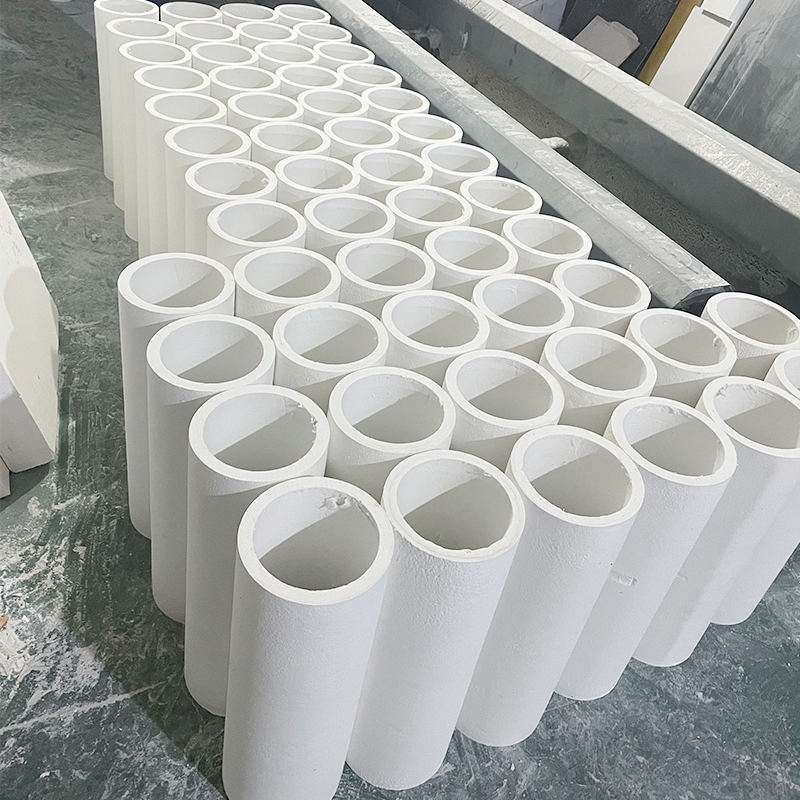 Ceramic Fiber Tube for High-Temperature Furnace InsulationHigh-temperature refractory tube sections with thermal shock resistance and low thermal conductivity; useful where installation quality and mean-temperature performance determine furnace reliability.View Product →
Published k-values are quoted at a mean temperature, so a figure measured at 50 °C flatters every material on a 400 °C line. The comparison below uses 200 °C mean temperature, which is closer to real steam and hot-oil duty.
Bare, a DN100 line at 300 °C sheds several hundred watts for every metre of length, and that figure is dominated by the outer surface, not by the pipe wall. The first 25 mm of insulation does most of the work; everything after that is diminishing returns on material cost. The index below compares relative loss per metre for a 300 °C line in still air, with the bare pipe set at 100.
Two practical readings follow. First, once a line is insulated, the largest remaining loss is almost always mechanical: uninsulated flanges, valves, hangers and gaps at expansion joints. Second, on high-temperature pipe the decision between two materials is rarely about k. It is about whether the chosen type stays intact for ten years at temperature — a slightly higher k that survives beats a lower k that shrinks, cracks or contaminates the pipe surface.
Across high-temperature pipe insulation work, the split between sectors is fairly stable. The indicative distribution below reflects typical project mix rather than published market research, but it explains why suppliers keep six families alive instead of settling on one.
The pattern matters when you buy. A steam-distribution project can standardise on one mineral wool family and one jacketing detail. A metallurgy site with flues, ladle preheaters and heat-treatment furnaces in the same building usually ends up running two systems side by side: mineral wool or calcium silicate on the utility pipework, ceramic fiber in the high-temperature path.
Write the design basis down. Continuous temperature, upset or excursion temperature and its duration, ambient conditions, indoor or outdoor location, wind exposure, and whether the line is austenitic stainless. Missing the excursion figure is the single most common cause of a re-specification.
Screen by temperature and chemistry. Remove any fibrous product within 100–150 °C of its classification limit, and any rigid product within 10–15% of its ceiling. On stainless, request the leachable chloride result against ASTM C871 and confirm the material meets ASTM C795.
Set the target, not the thickness. Define allowable heat loss per metre and a maximum surface temperature where contact is possible — 60 °C is the usual ceiling for personnel protection. Thickness then falls out of the calculation instead of being copied from an old drawing.
Detail the system, not just the material. Two layers with staggered joints above roughly 100 mm total thickness, expansion joints at intervals on hot lines, jacketing in aluminium or stainless with sealed overlaps, and banding spacing taken from the manufacturer's table rather than from habit.
Verify after the fact. Thermal imaging and spot heat-flux readings at commissioning expose joint gaps, compressed sections and missed valves while the contractor is still on site. Ask for the inspection and test plan before work starts, not after.
Where a rigid hot-face system suits the geometry better than a wrapped section — flue walls, furnace doors, burner quarls and flat ducting — an alumina-based board gives consistent density and clean cuts. One example of that family is this
 Alumina Ceramic Fiber Board for Rigid Hot-Face LiningsRigid alumina-based insulation board for flue walls, furnace doors and burner quarls; suited to hot-face lining where consistent density and clean cuts matter.View Product →
. Non-standard diameters, custom shapes and mixed material systems are usually the point at which a drawing review pays for itself; the engineering team can be reached through technical support.
Large-diameter headers, expansion loops and valve bodies rarely fit a preformed section, and that is where flexible blanket earns its place: it wraps irregular geometry, tolerates movement, and can be cut on site without special tooling. A
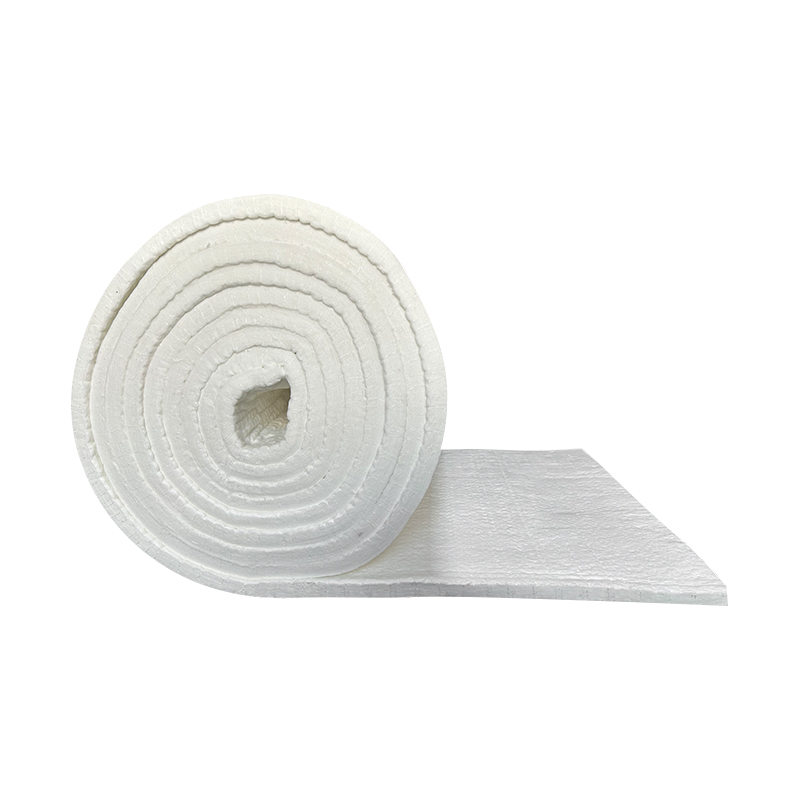 Flexible Ceramic Fiber Blanket for Pipes and FurnacesNeedle-punched blanket wraps headers, expansion loops and valve bodies, tolerating movement and on-site cutting for irregular transitions and repair zones.View Product →
suits exactly those transitions and repair zones.
The practical conclusion is unglamorous. Sort the candidate types by the temperature they can hold for a decade, screen out anything that comes close to its ceiling, check chloride where stainless is present, then spend the design effort on joints, jacketing and inspection instead of on another decimal place in the k-value. That sequence keeps a 300 °C steam line and a 1200 °C flue both inside their limits — with the same discipline applied to two very different materials.
Introduction: Aluminum silicate fiberboard material is currently a high-performance insulation material. Aluminum silicate fiberboard has excellent properties such as light w...
Introduction: Aluminum silicate refractory fiber products are made by selective processing of pyroxene, high-temperature melting, blow molding into fibers, solidification mol...
Introduction: 1、 Shaped ceramic fiber furnace lining for high alumina ceramic fiber board The shaped ceramic fiber furnace lining of high alumina ceramic fiber board mai...

An enterprise integrating design, R&D, production, sales and engineering services. Ceramic Fiber Board Manufacturers, Vacuum Heat Treatment Solutions in China
Phone: +86-13967261180
+86-17858398898
Email: ncjt@zjncjt.com
Arlen@zjncjt.com
Tel: +86-572-8295956
Add: Wulintou, Tangbei Village, Leidian Town, Deqing Country, Huzhou City, Zhejiang Province, China
Copyright © 2024 Zhejiang Nengcheng Crystal Fiber Co., Ltd. All Rights Reserved.

 English
 Español
 عربى