
E-mail: ncjt@zjncjt.com


A lab manager is trying to consolidate alumina powder into a transparent spinel window. The first furnace trial reaches temperature, but the sample still shows 4–6% porosity. The missing element is not more heat; it is a coordinated hot press system that applies load, holds vacuum, and controls cooling in one cycle.
Conclusion: a hot press system is a thermal-mechanical platform, not a standard furnace with a hydraulic ram added later. Density, cycle time, and part yield depend on how heating elements, insulation, press frame, vacuum level, and control logic are matched. Select the system around the material and the allowed pressure path, then confirm the hot zone and tooling can survive that path.
Hot pressing is a high-pressure, low-strain-rate powder consolidation process. The material is held at a temperature high enough for diffusion, while uniaxial pressure closes pores that cannot be removed by pressureless sintering alone. In a vacuum hot press, the atmosphere also removes oxygen and reaction products, which matters for metals, carbides, nitrides, and transparent ceramics.
Content
A practical hot press system has four interacting subsystems. Weakness in any one of them shows up as density scatter, cracked parts, or long pump-down and cooling times.
Graphite, MoSi2, SiC, or induction heating sets the usable temperature and atmosphere. Graphite suits high temperature and reducing conditions but needs careful insulation isolation. MoSi2 works in air and some oxidizing atmospheres but is sensitive to certain contaminants.
Press tonnage, ram stroke, platen flatness, and load control define the pressure window. A 50 t frame and a 200 t frame are not interchangeable when the die must reach 30–50 MPa on a large cross-section.
Vacuum, nitrogen, argon, or hydrogen changes binder removal, oxidation, and heat transfer. Vacuum hot pressing is common for reactive powders, but the pump set and leak rate must match the required partial pressure.
The recipe must coordinate temperature ramp, load application, dwell, and cooling. Applying full load at low temperature can crack a die; applying it too late leaves porosity that cannot be closed.
The heating element is often the first bottleneck. A system rated for 1600°C may only hold that temperature in a small hot zone, and only with clean contacts and matched power supply. Buyers should ask for the rated temperature at the work zone, not at the element surface.
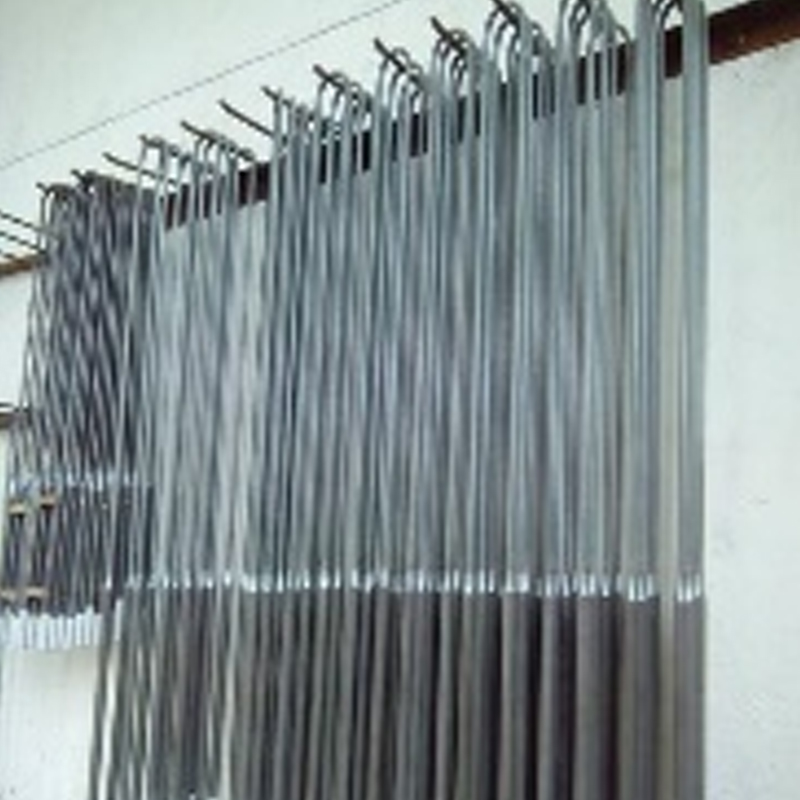 MoSi2 Heating Elements for High-Temperature FurnacesFor high-temperature furnace heating, these MoSi2 elements offer oxidation resistance and a 500–1700°C operating range in oxidizing atmospheres.View Product →
Insulation design is equally important. In a hot press, the liner must tolerate thermal cycling, pressure-induced vibration, and possibly reactive vapors. Fiber modules and boards reduce thermal mass, but they must be selected for the actual atmosphere and temperature. A dense lining may last longer in one zone while wasting cycle time in another.
Purchase decisions often focus on tonnage and maximum temperature. Production performance is usually set by less visible metrics: achieved density, cycle time, heat loss, and temperature uniformity. The chart below is illustrative, not a specification, but it shows where a hot press system can lose value.
A system with a long cooling cycle can meet density targets yet fail production economics. A system with fast heating but poor uniformity can produce warped or cracked parts. The useful benchmark is the complete cycle at the part cross-section, not the furnace nameplate.
Uniaxial vacuum hot pressing is the most common route for lab-to-small-production work. HIP and SPS solve different problems, and a conventional hot press is a poor substitute when the part geometry or heating rate falls outside its window.
Demand is concentrated in applications where residual porosity changes optical, electrical, or mechanical performance. The distribution below is a practical planning view, not a market statistic.
For ceramics, the value is pore removal and grain-boundary control. For metals and composites, it is bonding and density without excessive grain growth. For research, it is repeatable small-batch cycles that can be scaled later.
A hot press system should be specified from the process backward. This sequence avoids buying tonnage that cannot be used or a hot zone that cannot hold the required atmosphere.
State the powder, target density, allowed grain size, and whether transparency or purity is required. These requirements decide the atmosphere and heating element family.
Multiply the part area by the required pressure, then add a margin for die friction and off-center loading. Confirm the frame, platen, and ram can hold that load at temperature.
Graphite, MoSi2, and induction each impose different atmosphere and maintenance rules. A vacuum level that is adequate for one powder may be insufficient for another.
Match insulation thickness and geometry to the temperature profile. Too much thermal mass slows cooling; too little increases heat loss and element load.
Run a full heat-load-cool cycle with a representative part and die. Record vacuum, power, ram position, and final density. Accept the system only after the cycle repeats.
Insulation is often treated as a consumable, but it affects the whole recipe. A ceramic fiber heating module block can simplify the hot zone build by combining thermal insulation with a defined mounting surface for resistance heating. The trade-off is that the module must be checked for shrinkage, atmosphere compatibility, and mechanical support before it is used under load.
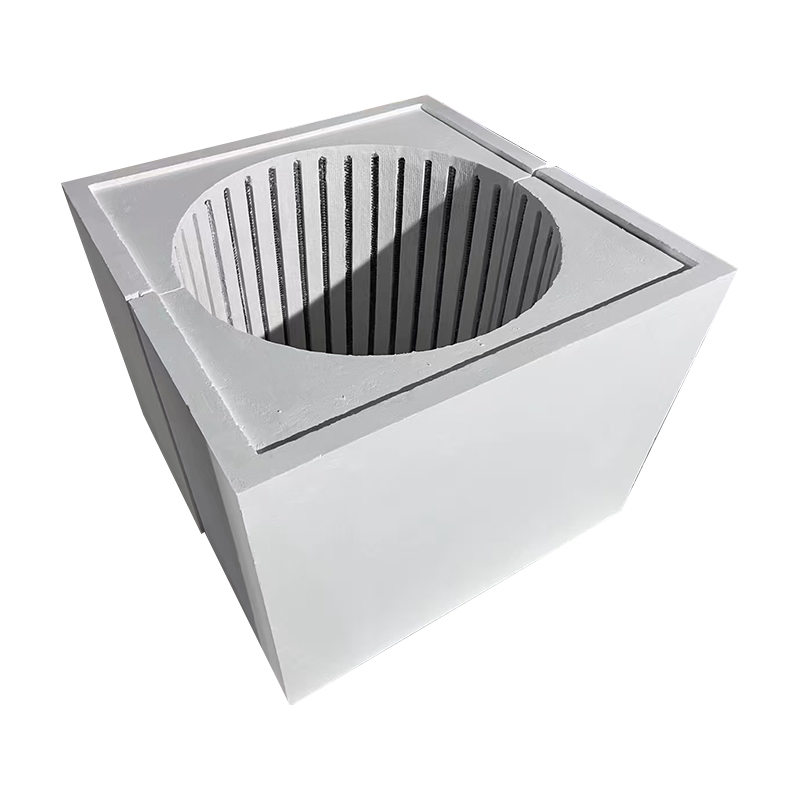 Ceramic Fiber Heating Module Block for Electric Resistance FurnacesCombines fiber insulation with embedded resistance wire for 300–1300°C furnace hot zones and offers an alternative to traditional resistance heating equipment.View Product →
For budgeting, separate the capital cost from the cost per good part. A lower-cost system that adds two hours of cooling per cycle may cost more per year than a better-insulated system with a shorter turnaround. The same logic applies to tooling: a spare die set and a fast thermocouple check can recover more uptime than a higher tonnage alone.
Hot press systems fail in predictable places. A maintenance plan should cover the hot zone, the hydraulic circuit, and the vacuum path separately.
A hot press system is only as good as the cycle it can repeat. Before comparing quotations, ask for the work-zone temperature, usable platen size, pressure at temperature, vacuum level under load, cooling rate, and the expected tooling life. Then ask for a cycle test on a material close to your own.
The strongest configuration is not the one with the highest tonnage or the highest temperature label. It is the one where the heating element, insulation, press frame, atmosphere, and control recipe are sized for the same part. That alignment is what turns a high-temperature press into a reliable production or research asset.
Introduction: Aluminum silicate fiberboard material is currently a high-performance insulation material. Aluminum silicate fiberboard has excellent properties such as light w...
Introduction: Aluminum silicate refractory fiber products are made by selective processing of pyroxene, high-temperature melting, blow molding into fibers, solidification mol...
Introduction: 1、 Shaped ceramic fiber furnace lining for high alumina ceramic fiber board The shaped ceramic fiber furnace lining of high alumina ceramic fiber board mai...

An enterprise integrating design, R&D, production, sales and engineering services. Ceramic Fiber Board Manufacturers, Vacuum Heat Treatment Solutions in China
Phone: +86-13967261180
+86-17858398898
Email: ncjt@zjncjt.com
Arlen@zjncjt.com
Tel: +86-572-8295956
Add: Wulintou, Tangbei Village, Leidian Town, Deqing Country, Huzhou City, Zhejiang Province, China
Copyright © 2024 Zhejiang Nengcheng Crystal Fiber Co., Ltd. All Rights Reserved.

 English
 Español
 عربى