
E-mail: ncjt@zjncjt.com


The short version: A diffusion bonding furnace is a vacuum hot press. Before you compare quotes, lock down three specifications: maximum working temperature of the hot zone, pressing force and platen parallelism, and the insulation system protecting that hot zone. These three decide joint quality, energy cost, and how often you will rebuild the furnace.
Diffusion bonding joins two clean, flat surfaces in the solid state. The parts are pressed together under vacuum or inert atmosphere at roughly 50–80% of the base material's melting temperature, and atoms migrate across the interface until the joint matches the parent metal in strength and microstructure. The furnace controls the three variables that make that happen: heat, uniaxial pressure, and atmosphere.
Unlike a standard box furnace, a diffusion bonding furnace is a hybrid system — part vacuum chamber, part hydraulic press, part precision thermal enclosure. Understanding how these systems are actually constructed will save you from buying the wrong machine for a very specific joining process.
Content
A typical commercial diffusion bonding furnace is a vacuum furnace with hydraulic rams that apply pressure through graphite tooling and into the component stack. Radiant heat from the hot zone raises the parts to bonding temperature; the vacuum keeps the faying surfaces free of oxides; the ram delivers pressure that flattens surface asperities and promotes atomic diffusion.
The three subsystems you are really buying are:
Most bonding runs at 10-2 to 10-4 Pa. Titanium alloys need the deep end of that range or high-purity argon backfill; stainless and nickel alloys tolerate the shallower end. You need a two-stage vacuum system — rotary pump plus diffusion or turbomolecular pump — with a leak rate below 5×10⁻⁷ Pa·m3/s.
Hydraulic rams apply 1–30 MPa on the joint area. A 50 mm coupon needs under 4 tons; a 300 mm structural panel needs over 100 tons. Real quality depends on platen parallelism at operating temperature and load — ±0.05 mm is a realistic acceptance criteria.
MoSi2 and SiC elements handle most metal bonding up to 1200–1400°C at reasonable cost. Above that, graphite felt insulation and graphite rod or tube elements take over. For ultra-clean processes above 1600°C, metal hot zones using molybdenum or tungsten ribbons reach 2200°C but cost substantially more to build and maintain.
For bonding programs that approach 1600–2000°C, the vacuum carbon tube furnace configuration is what most suppliers specify: graphite elements radiate uniformly, graphite felt insulation is easy to replace, and the all-graphite hot zone resists thermal shock.
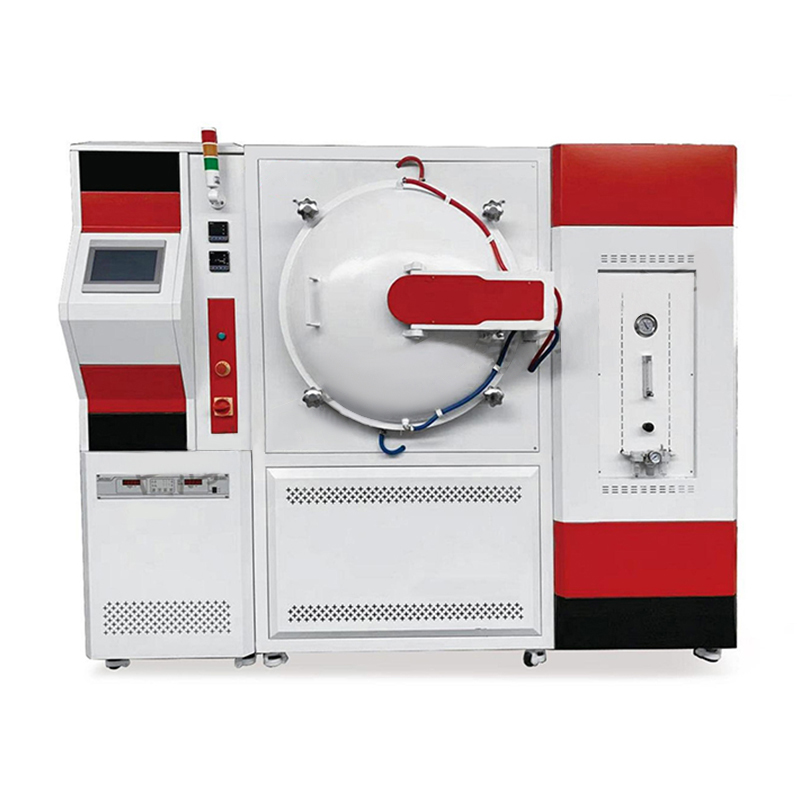 Graphite-Element Vacuum Carbon Tube Furnace for High-Temperature BondingThis furnace uses a graphite heating element for uniform radiation up to 2300°C in vacuum or protective atmospheres. It suits ceramic sealing, hard alloy preparation, and rare earth purification, making it relevant when evaluating furnaces for bonding near 1600–2000°C.View Product →
Brochures emphasize maximum temperature and ultimate vacuum. What actually separates a furnace that passes metallographic inspection from one that produces intermittent voids are several less-publicized factors.
Rough weighting based on published bond-quality studies across titanium, nickel, and stainless couples; your mileage varies by alloy.
Temperature accounts for the largest share because it controls diffusion coefficient and creep deformation. Surface preparation matters almost as much: machined or ground surfaces with low roughness bond far more reliably than as-shipped plate. Pressure mainly helps break up surface oxides; once a bond line closes, additional load yields little benefit. Vacuum level and hold time matter most at the extremes — titanium at poor vacuum absorbs oxygen and nitrogen, and overly short hold times produce incomplete contact.
The main purchasing decision is heating technology — whether to use graphite, refractory metal, or silicon-carbide-based heating elements. The comparison below represents typical commercial configurations.
Above 1600°C, the practical choice is between graphite and tungsten elements. Graphite is cheaper and easier to maintain; tungsten offers cleaner vacuum and higher peak temperature. A vacuum tungsten wire furnace is the standard answer when your bonding cycle runs hotter than 2000°C or demands ultra-clean hot-zone conditions.
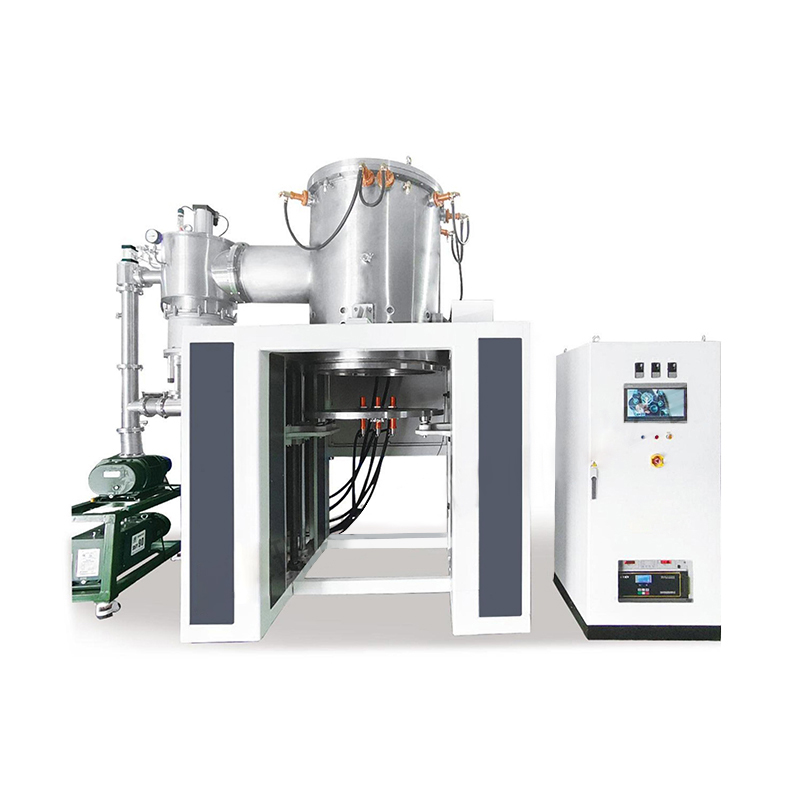 Vertical Vacuum Tungsten Wire Furnace with Mesh Heating for Clean SinteringWith a round cavity and multi-layer tungsten mesh heating, this furnace provides uniform heat and a clean hot zone for ultra-high-temperature sintering. It is suited for bonding cycles exceeding 2000°C or processes requiring minimal contamination, matching the prior discussion on graphite versus tungsten.View Product →
Diffusion bonding demand is concentrated in industries where monolithic production would be too expensive or impossible. The chart below reflects typical sourcing patterns in furnace procurement.
Aerospace drives the largest share because diffusion bonding is one of the few ways to form hollow titanium structures and superplastic-formed panels without fasteners or welds. Electronics and semiconductor manufacturers use it for hermetic packages, heat sinks, and specialty sensors. Automakers are newer entrants, bonding battery tab stacks and lightweight aluminum structures at lower temperatures and shorter cycles, often in adapted furnaces rather than dedicated hot presses.
If your parts are small and flat, a compact hot press with a ceramic fiber-insulated hot zone is often sufficient. If your parts are large, tall, or formed together with superplastic forming, budget for a larger vacuum chamber and a multi-zone hot zone to hold temperature uniformity across the whole stack.
Follow a material-first sequence. It will prevent most selection mistakes.
Required force equals target pressure in MPa times joint area in mm2. A 50 mm coupon at 10 MPa is under 4 tons; a 300 mm structural member at 15 MPa exceeds 100 tons. That single calculation determines frame, ram, and platen costs.
Titanium alloys bond at 850–950°C; nickel superalloys at 1000–1150°C; ceramics and intermetallics at 1200–1600°C. Bonding temperature plus ram capability dictates whether you need graphite, molybdenum, or tungsten heating elements.
Above 1400°C, graphite felt or rigid graphite board is standard. Below 1200°C, ceramic fiber modules or boards reduce cost and heat-up energy. Insulation is also your biggest consumable — choose a design with easily replaceable panels.
Ask the vendor for flatness and parallelism tolerances under full load at operating temperature. ±0.05 mm across the platen is achievable; wider tolerance produces uneven bonds on large-area parts.
Titanium needs 10-3 Pa or argon backfill; copper and aluminum tolerate 10-2 Pa. Include mass flow controllers if your process uses partial-pressure argon, nitrogen, or forming gas.
Build a coupon-bonding program into the purchase. Cut, polish, and inspect joints by metallography or ultrasonic C-scan before final acceptance. Find voids at the acceptance stage, not during paid production.
A diffusion bonding furnace is typically a five-to-ten-year asset, and its five-year running cost often reaches 1.5–2× the original purchase price. Most of that is heating elements, insulation, and tooling.
For hot-zone rebuilds, using modular ceramic fiber products shortens downtime considerably. Many operators keep a spare set of ceramic fiber modules on-site, so a damaged front wall or door seal can be swapped in a single shift instead of a full refractory rebuild.
 Folded Ceramic Fiber Module Lining with M-Type Anchors for Furnace RebuildsThese ceramic fiber modules offer quick installation, low thermal conductivity, and seamless insulation. Built-in M-type anchors improve strength at high temperatures. They are ideal for hot-zone rebuilds or spare linings, helping reduce furnace downtime as noted in the surrounding discussion.View Product →
Compliance matters beyond calibration. Pressure vessels generally require local certification, and export markets usually require CE marking. Confirm before ordering that the furnace nameplate and documentation match the requirements of the destination country.
Also watch for eutectic reactions between dissimilar materials in the hot zone. A low-melting eutectic can form where graphite tooling meets certain metal parts, causing localized damage and contamination. Proper barrier layers and thermocouple placement prevent most occurrences.
Introduction: Aluminum silicate fiberboard material is currently a high-performance insulation material. Aluminum silicate fiberboard has excellent properties such as light w...
Introduction: Aluminum silicate refractory fiber products are made by selective processing of pyroxene, high-temperature melting, blow molding into fibers, solidification mol...
Introduction: 1、 Shaped ceramic fiber furnace lining for high alumina ceramic fiber board The shaped ceramic fiber furnace lining of high alumina ceramic fiber board mai...

An enterprise integrating design, R&D, production, sales and engineering services. Ceramic Fiber Board Manufacturers, Vacuum Heat Treatment Solutions in China
Phone: +86-13967261180
+86-17858398898
Email: ncjt@zjncjt.com
Arlen@zjncjt.com
Tel: +86-572-8295956
Add: Wulintou, Tangbei Village, Leidian Town, Deqing Country, Huzhou City, Zhejiang Province, China
Copyright © 2024 Zhejiang Nengcheng Crystal Fiber Co., Ltd. All Rights Reserved.

 English
 Español
 عربى
عربى