
E-mail: ncjt@zjncjt.com


When a kiln operator stacks one hundred kilograms of ceramic ware onto a setter tray, that tray must stay dimensionally stable while the furnace cycles through 1,300°C or higher. A corundum mullite support tray is engineered for exactly this job. It combines the wear resistance and thermal shock tolerance of corundum with the low expansion and creep resistance of mullite, giving furnace users a more predictable load-bearing platform.
Operational conclusion: For kilns and industrial furnaces operating above 1,200°C under cyclic loading, corundum mullite support trays deliver a longer service life, lower deformation rate, and better product yield than conventional clay or aluminosilicate trays. The upfront cost is higher, but the total cost per firing cycle is usually lower.
Content
The name tells the story. Corundum contributes hardness and excellent thermal shock resistance, while mullite contributes low thermal expansion and outstanding creep resistance. Together they make a composite refractory that holds its shape at high temperature while absorbing repeated heating and cooling.
Three material behaviors matter most in tray operation:
The composite structure spreads thermal stress, so the tray survives rapid heating cycles without forming deep cracks.
Low creep deformation lets the tray keep a nearly flat top surface even under heavy loads during long sintering cycles.
Consistent tray geometry means the ware sits in the same position every cycle, which helps maintain uniform temperature distribution.
For furnace builders who want to combine a rigid tray with a soft thermal buffer, custom shaped ceramic fiber parts can fit around or beneath the tray. They are manufactured to precise drawings for this kind of application.
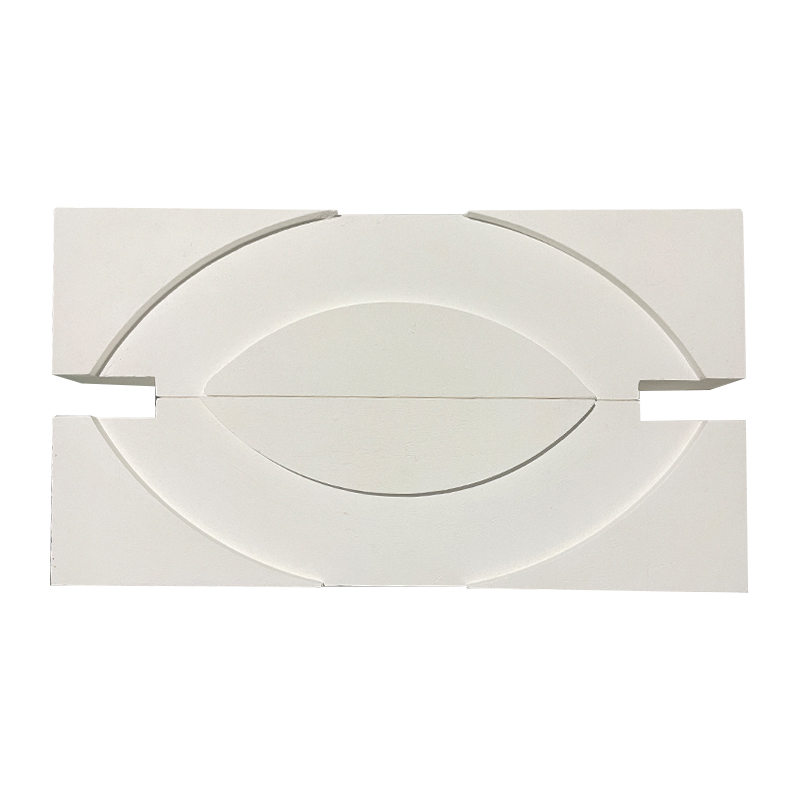 Custom Shaped Ceramic Fiber Parts for Furnace BuildersThese vacuum-formed ceramic fiber products are made to drawings for complex thermal requirements, providing compressive strength and thermal shock resistance for hot surfaces like burner bricks and observation holes.View Product →
The choice becomes clear when you compare the main options side by side. The following data is typical for commercial-grade materials and should be used as a preliminary screening guide.
SiC excels in thermal conductivity but oxidizes more readily in an oxidizing atmosphere, which makes it a less predictable choice for long cyclic service. Clay trays are economical but suffer from higher creep and shorter life. Corundum mullite offers a balanced package for most high-temperature ceramic and powder processing lines.
Corundum mullite support trays appear throughout industries where precision and repeatability are non-negotiable. The chart below shows an estimated distribution of demand based on typical furnace utilization patterns.
Each sector has its own load profile. Electronic ceramics usually cycle quickly and require precise surface contact; structural ceramics often run longer and heavier, placing more stress on creep resistance. A corundum mullite tray performs well in both extremes.
A supplier may quote the maximum service temperature, but that number does not reveal what happens over 500 cycles. Three hidden metrics deserve attention during tray evaluation: deformation under load, thermal cycle life, and surface reaction depth.
The bars above are illustrative, not measured data. They show that while corundum mullite performs well in cycle life and creep, it can be slightly less thermally conductive than silicon carbide. For kiln operators who need to lower energy consumption, pairing a rigid support tray with a lightweight insulating layer is a practical way to improve heat-up efficiency without sacrificing load capacity. Our  Alumina Ceramic Fiber Board for Thermal InsulationThis rigid board, made from compressed shattered cotton, offers low thermal conductivity and high strength, serving as an insulating layer to reduce heat loss and improve heat-up efficiency in kilns.View Product → can serve as a thermal buffer under the tray or inside the furnace wall to reduce heat loss.
Choosing the right support tray is not just a temperature rating exercise. The correct approach starts with a simple question: what is the total cost per firing cycle?
Follow these steps when selecting a tray:
ROI usually improves after 60–100 cycles. A lower-cost clay tray may need replacement twice as often, and each replacement means loading downtime, lost production, and re-calibration. Corundum mullite trays also reduce finish-related defects, which is often worth more than the tray price itself.
Even a premium corundum mullite tray wears out if handled improperly. The following practices help extend service life and maintain process stability.
For compliance, place the tray specification within the same quality system used by the rest of your furnace line. If your plant follows ISO 9001, define an inspection procedure for incoming trays and keep records of temperature, load, and cycle count. This documentation matters when you investigate a batch defect or when a customer audit asks you to demonstrate control over critical kiln furniture.
When selecting auxiliary insulation for the tray assembly, consult the latest guidance on high-temperature insulation materials to avoid mismatched thermal expansion between the tray and its supporting structure.
Introduction: Aluminum silicate fiberboard material is currently a high-performance insulation material. Aluminum silicate fiberboard has excellent properties such as light w...
Introduction: Aluminum silicate refractory fiber products are made by selective processing of pyroxene, high-temperature melting, blow molding into fibers, solidification mol...
Introduction: 1、 Shaped ceramic fiber furnace lining for high alumina ceramic fiber board The shaped ceramic fiber furnace lining of high alumina ceramic fiber board mai...

An enterprise integrating design, R&D, production, sales and engineering services. Ceramic Fiber Board Manufacturers, Vacuum Heat Treatment Solutions in China
Phone: +86-13967261180
+86-17858398898
Email: ncjt@zjncjt.com
Arlen@zjncjt.com
Tel: +86-572-8295956
Add: Wulintou, Tangbei Village, Leidian Town, Deqing Country, Huzhou City, Zhejiang Province, China
Copyright © 2024 Zhejiang Nengcheng Crystal Fiber Co., Ltd. All Rights Reserved.

 English
 Español
 عربى
عربى