
E-mail: ncjt@zjncjt.com


A process engineer sizing the lining for a 1300 °C debinding and sintering furnace usually ends up with three quotes on the desk: dense fireclay brick at the lowest unit price, 0.8 g/cm³ insulating firebrick in the middle, and a 128 kg/m³ ceramic fiber module system at the top. The unit price ranking and the total cost ranking rarely point at the same option, and the reason sits in two numbers nobody puts on the quotation: continuous use temperature and lining mass.
The short answer: select high temperature refractory materials by continuous working temperature and furnace chemistry first, then by density and thermal conductivity. A lining over-specified on temperature but too dense on mass wastes energy on every cycle; a lining under-specified on chemistry or shrinkage fails within a few months, whatever it cost.
Two rules cover most specifications: classification temperature is a test result, not a service rating, and the hot face must be chosen for the worst hour the furnace will ever see, not the average day.
The comparison below is the one worth making before price. Figures are typical published ranges for common commercial grades; the thermal insulation materials range covers fiber-based options in more detail.
Content
Refractory literature separates normal refractories with fusion temperatures around 1580–1780 °C (fireclay being the standard example) from high refractories at roughly 1780–2000 °C (chromite-based types). Fusion temperature tells you the material will not melt; it says very little about whether the lining survives five years of cycling. For fibrous insulation the equivalent number is the classification temperature, measured by a 24-hour shrinkage test, and continuous service is normally set 100–150 °C below it.
Stored heat scales with density, specific heat and the thickness of the layer actually soaked to temperature. For a 200 mm lining heated across roughly 1000 K, the fully soaked layer of dense firebrick holds on the order of 100–120 kWh per square metre, insulating firebrick at 0.8 g/cm³ around 40–50 kWh, and a 128 kg/m³ fiber system only 6–8 kWh. In a furnace that cycles daily, that difference usually outweighs wall losses.
The trade-off is mechanical. Fiber has no load-bearing capacity, erodes under high-velocity gas, and should not contact molten metal or heavy slag. The workable pattern is a fiber hot face with a dense brick or castable wear zone where the charge or the flame impinges, and fiber backup where the only job is holding heat in.
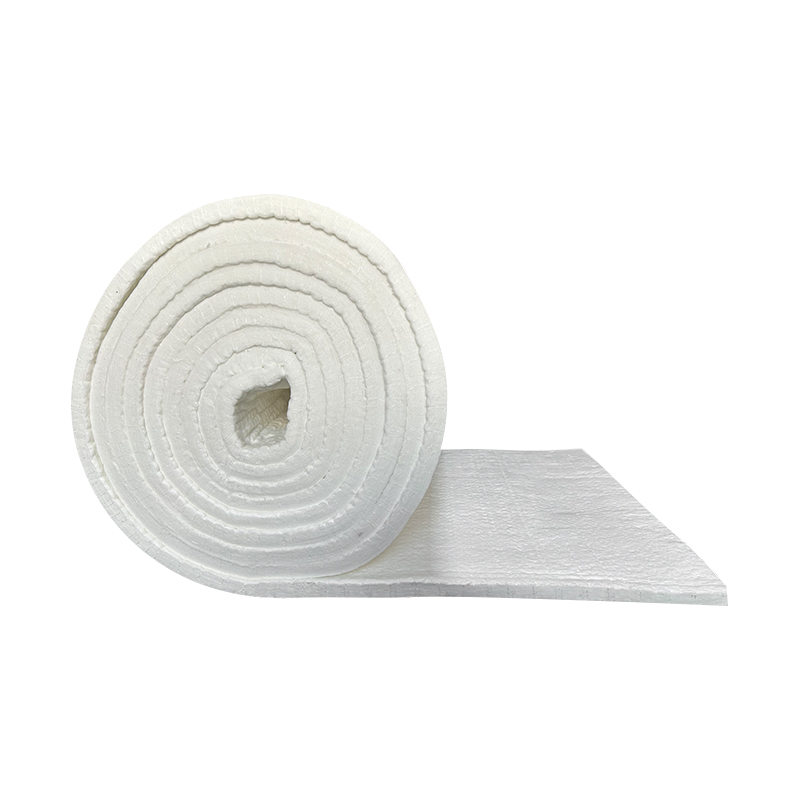 NC Ceramic Fiber Blanket for Thermal Insulation BackupReview this double needle-punched blanket where fiber serves as heat-holding backup, not load-bearing hot face; grades span 1260–1600°C.View Product →
Most specification errors arrive on the datasheet as vague labels rather than missing numbers. Check these six items before approving a grade:
Boards are the practical answer where the hot face must stay flat and hold a shape, for example in a batch muffle or a kiln car deck. They cost more per square metre than blanket and are less forgiving at anchors, so the drawing review matters as much as the material grade.
 Alumina Ceramic Fiber Board for Flat Hot-Face LiningsConsider this board where a flat, shape-holding hot face must resist flame and gas flow; available in NC1260–NC1800 grades.View Product →
Demand for high temperature refractory materials follows the industries that run hot processes continuously. The split below is an indicative pattern for heavy-industry consumption, useful for judging which service conditions a supplier meets most often, not a statistical survey.
Read it as a hint about failure modes. Steel and cement users worry about alkali attack and abrasion; ceramics and glass users worry about contamination and thermal shock; laboratory and pilot users worry about small batch flexibility and repeatable temperature uniformity. A supplier whose catalogue is built around electric furnace chambers will usually be stronger on the last group than on slag resistance.
Running the sequence in order avoids the common mistake of picking a material before the duty is written down.
Peak temperature and hold time, atmosphere, contaminants, mechanical load, gas velocity, and how often the furnace cycles per week.
Set continuous use 100–150 °C above the working setpoint for fiber, or one fusion class above the peak for brick.
Fiber-only, fiber over IFB, or a dense wear face with fiber backup. Draw the anchor layout before ordering material.
Shrinkage at setpoint, conductivity at mean temperature, chemistry, density tolerance, and a batch test report tied to the delivered lot.
Binder burnout curve, expansion joints, hold points and ventilation, agreed in writing before installation starts.
Where the highest temperature is needed, polycrystalline mullite fiber carries the hot face at 1500–1600 °C without the mass penalty of brick, at a price that only makes sense when the chamber is small, cycling is frequent, or cleanliness matters. It is also the grade most sensitive to contamination, so the furnace atmosphere and the charging practice have to be reviewed honestly.
 Polycrystalline Mullite Fiber Cotton for High-Temperature InsulationUse this lightweight 72% alumina fiber where 1500–1700°C service and low mass matter; review atmosphere and charging for contamination sensitivity.View Product →
Most premature lining failures are installation failures, not material failures. The recurring ones are worth listing for any procurement review:
Installation detail changes measured performance more than most buyers expect. Module alignment, joint compression and anchor embedding decide whether the calculated conductivity survives contact with the real furnace; the practical checks are set out in this ceramic fiber blanket furnace lining guide.
The workable rule for high temperature refractory materials is to specify in this order: duty, chemistry, continuous temperature, then density and cost. If a quotation cannot state shrinkage at your setpoint and conductivity at a named mean temperature, the grade is unverified regardless of how attractive the price looks. Buy the lining that suits the cycle the furnace actually runs, and put the savings into anchors, expansion joints and a documented first heat-up, where they are least likely to be lost.
Introduction: Aluminum silicate fiberboard material is currently a high-performance insulation material. Aluminum silicate fiberboard has excellent properties such as light w...
Introduction: Aluminum silicate refractory fiber products are made by selective processing of pyroxene, high-temperature melting, blow molding into fibers, solidification mol...
Introduction: 1、 Shaped ceramic fiber furnace lining for high alumina ceramic fiber board The shaped ceramic fiber furnace lining of high alumina ceramic fiber board mai...

An enterprise integrating design, R&D, production, sales and engineering services. Ceramic Fiber Board Manufacturers, Vacuum Heat Treatment Solutions in China
Phone: +86-13967261180
+86-17858398898
Email: ncjt@zjncjt.com
Arlen@zjncjt.com
Tel: +86-572-8295956
Add: Wulintou, Tangbei Village, Leidian Town, Deqing Country, Huzhou City, Zhejiang Province, China
Copyright © 2024 Zhejiang Nengcheng Crystal Fiber Co., Ltd. All Rights Reserved.

 English
 Español
 عربى