



 English
 Español
 عربى
عربى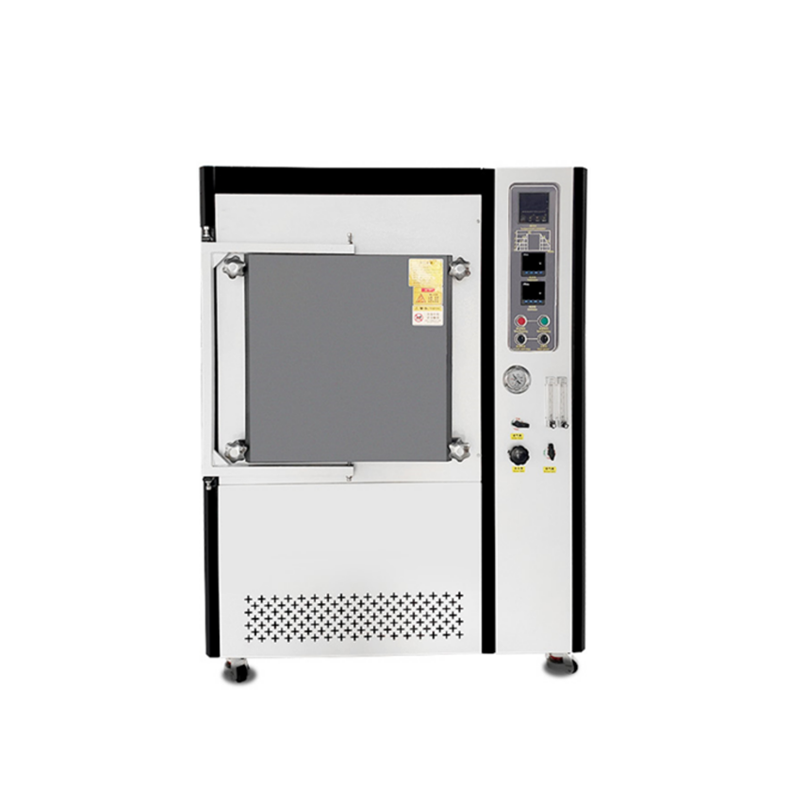
Laboratory Nitrogen Atmosphere Box Furnace
Main Applications:
This high-temperature atmosphere furnace is widely used in industries and research fields such as ceramics, lithium battery cathode and anode materials, metallurgy, electronics, glass, chemical engineering, machinery, refractory materials, advanced materials, building materials, universities, research institutes, and industrial and mining enterprises.
It is primarily applied for powder calcination, ceramic sintering, high-temperature experiments, material processing, as well as high-temperature atmosphere sintering, atmosphere reduction, binder burnout (debinding), CVD experiments, vacuum annealing, and other thermal treatment processes.
Product Features:
This high-temperature atmosphere furnace uses resistance wire as the heating element and adopts a double-layer shell structure with a 31-segment programmable temperature control system. It features phase-shift triggering and thyristor (SCR) control for precise temperature regulation.
The furnace chamber is designed with an independently developed dual-chamber structure and is constructed from high-purity alumina ceramic fiber materials. Based on different process requirements, the chamber is assembled using a customized modular design. This design ensures uniform temperature distribution, low external surface temperature, rapid heating and cooling rates, and excellent energy-saving performance.
The outer casing is made of carbon steel with a painted anti-corrosion finish, ensuring durability and long service life.
Technical Advantages:
This furnace is a high-performance and energy-efficient product developed using advanced international technologies. It incorporates energy-saving alumina insulation materials and a double-layer structure, which effectively reduces the external surface temperature to near ambient levels while ensuring uniform temperature distribution inside the chamber.
An inner fire-blocking door is installed at the furnace opening to prevent heat loss, providing thermal insulation and significantly reducing the outlet temperature.
With its excellent overall performance, this furnace reaches a leading level in the domestic market.
Operating Conditions:
The equipment should be installed in a factory or an indoor environment.
Ambient temperature in the control area: -5°C to 35°C.
The ground must be flat and free of corrosive gases.
Basic Requirements / Configuration:
Power Supply: 380V, single-phase, 15 kW, 50 Hz
Lifting Equipment: 1 ton capacity (actual furnace weight is approximately 500 kg)
Floor Space Required: 1.4 m²


| 1 | Voltage (AC) | 380V |
| 2 | Heating Power | 15KW |
| 3 | Furnace Chamber Dimensions | 400*300*300mm (D*W*H) |
| 4 | External Dimensions | 1061*1224*1533mm (D*W*H, height excluding exhaust fan). |
| 5 | Placement Method | 1 row, 2 layers, 1 row (1 sagger per furnace), specific configuration depends on customer capacity requirements; |
| 6 | Sintered Products | High-temperature sintering treatment of materials |
| 7 | Material Loose Density | As per actual needs |
| 8 | Charge Amount | As per actual needs |
| 9 | Loss on Ignition Rate | As per actual needs |
| 10 | Daily Production Capacity | As per actual needs |
| 11 | Maximum Operating Temperature | 1200℃ |
| 12 | Common Operating Temperature | ≤1000℃ |
| 13 | Temperature Control Accuracy | ±1℃ |
| 14 | Cross-sectional Temperature Uniformity | ±5℃ |
| 15 | Number of Temperature Zones | Single temperature zone |
| 16 | Temperature Sensing Element | (N-type thermocouple), located at the rear of the furnace. |
| Temperature measurement range: Room temperature - 1200℃ | ||
| 17 | Control Method | Control method: Employs a 31-segment programmed temperature rise system, automatically operating from room temperature to the set temperature after the program is completed. The system uses SCR control and features a modular design for simple structure and easy maintenance. It utilizes Xiamen Dedian temperature controllers with SCR control, programmable control, multi-segment power limiting, and multi-set PID parameter self-tuning, allowing for free setting of constant temperature and heat preservation curves. The entire control system is integrated into the Kunlun Tongtai touchscreen interface. |
| 18 | Number of Programmable Curve Segments | With 31 adjustable levels (allowing for stepped heating), it reduces the unnecessary hassle caused by manual settings. |
| 19 | Heating Rate | Adjustable heating speed from 1℃/h to 10℃/min. |
| 20 | Digital Display | Dual display for measured and set temperatures, and bar graph display for heating power. |
| 21 | Control Features | Modular control system with long-life design for key components; simple, reliable, stable, and highly accurate process. |
| 22 | Inlet/Exhaust Port Distribution | Air inlets are located on both sides and the rear of the furnace; exhaust outlets are located at the top of the furnace, using direct metal pipes for rapid impurity removal, preventing damage to the pipes due to excessively high exhaust temperatures. |
| 23 | Heating Element | High-quality resistance wire heating devices are used, installed on both sides and the bottom of the furnace chamber. |
| 24 | Vacuum System | Equipped with a mechanical pump, the vacuum level can reach -0.1MPa. |
| 25 | Pressure Gauge | The equipment is equipped with pressure gauges to monitor the furnace pressure in real time, improving operational safety. The pressure gauge range is -0.1MPa to 0.15MPa. |
| 26 | Pressure Range | The furnace can withstand a slight positive pressure, ≤0.05MPa, and features an automatic pressure relief valve. Pressure parameters can be set on the pressure gauge, and automatic venting occurs in case of overpressure. |
| 27 | Switch | The equipment has an independent switching system for air inlet, exhaust, and vacuum, allowing for flexible switching to achieve various operating conditions such as pressure holding, atmospheric, and air. |
| 28 | Protective Gas | It can accept inert gases such as nitrogen and argon, as well as air and oxygen. |
| 29 | Insulation Material | Alumina fiber insulation material is used, with a 150mm insulation layer. |
| 30 | Furnace Door | The furnace door uses a parallel sliding sealing method and can rotate 360 degrees when opened, avoiding the leakage caused by uneven pressure on one side of a hinged door, thus ensuring the furnace's airtightness. The furnace door is water-cooled. |
| 31 | Outer Shell | The furnace body and shell are welded from steel plates and profiles, and the outer shell is equipped with a removable protective plate, which is electrostatically sprayed and baked. The workmanship is exquisite, and the appearance is elegant. |
| 32 | Furnace Chamber Structure | The double-layer furnace shell structure and air-cooled circulation reduce the outer shell temperature. The surface temperature of the shell is <45℃. The inner furnace chamber uses alumina ceramic material, which improves the heating efficiency of the equipment and extends its service life. The furnace door and furnace body are connected by hinges, and the seal between the door and furnace body uses a double-layer seal: an internal asbestos packing seal and an external high-temperature silicone ring and stainless steel locking ring. The furnace legs have a V-shaped structure, with connecting plates and reinforcing plates welded to the bottom of both sides between the legs for easy installation. Four casters are also provided for easy movement. |
| 33 | Energy Saving Performance | Lightweight, heats up quickly, saves over 50% on energy, and saves time and effort. |
| 34 | Configuration List | 1. Heating furnace (1 unit) |
| 2. Electrical control cabinet (1 unit) | ||
| 3. Operation manual (1 copy) | ||
| 4. Electrical instrument manual (1 set) | ||
| 5. Type N thermocouple (1 set) | ||
| 6. Temperature compensation wire (5 meters) | ||
| 7. Inlet valve and outlet valve (1 set) | ||
| 9. Vacuum pump (1 unit) | ||
| 35 | Alarm Function | 1. Over-temperature alarm |
| 2. Thermocouple breakage alarm |
-
A 20-tonne Acheson graphitization furnace can hold full power for 24 to 40 hours and then need five to seven days of cooling before anyone opens it. Peak temperature is the headline number, but cost per tonne is decided by three quieter things: the furnace type, the condition of the insulation, and the shape of the power profile. Two shops running the same 2800 °C schedule can differ by 30 percent in kilowatt-hours per tonne. The gap is usually not the transformer. It is compressed graphite fel...

