



 English
 Español
 عربى
عربى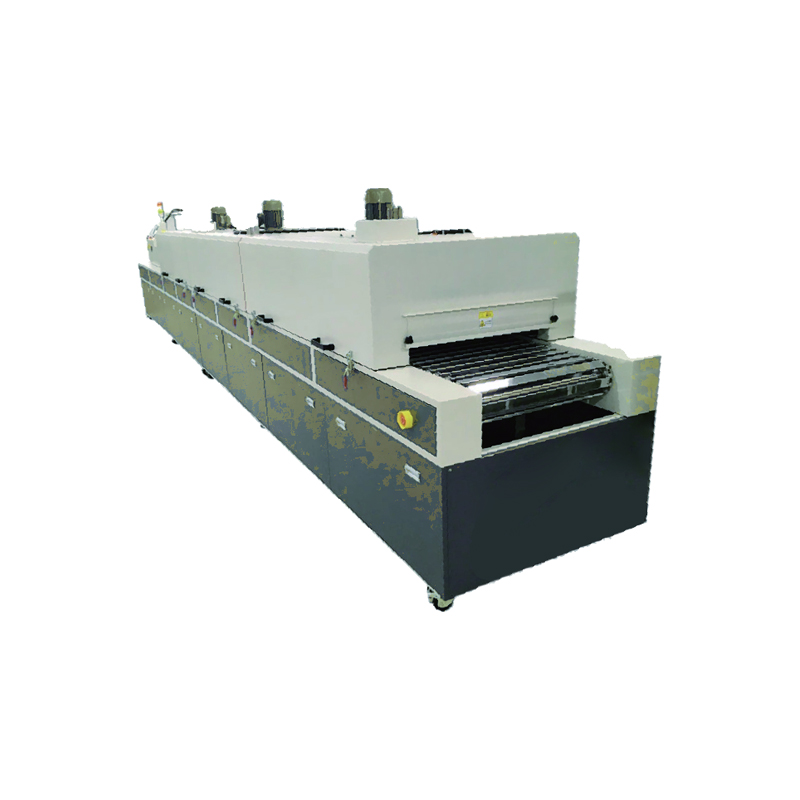
1100°C High-temperature Sintering Furnace with mesh belt drive system
This sintering furnace uses a muffle-protected mesh belt to continuously transport parts within the furnace. It is primarily used for sintering powder metallurgy products, reducing metal powders, and pre-firing, firing, or heat treating electronic products in a protective atmosphere or air. The mesh belt drive system consists of a high-temperature-resistant mesh belt and drive mechanism. The furnace body comprises a feed section, pre-firing section, sintering section, slow cooling section, water cooling section, and discharge section. Applications include integrated circuits, power electronics, glass, solar panels, circuit boards, chemicals, pharmaceuticals, packaging, and annealing and drying processes.


Product Information
| Model | Rated power | Maximum temperature | Work area size | Atmosphere |
| SL-WX100 | 21KW | 1100℃ | 1000x120X80MM | Nitrogen protection |
| SL-WX150 | 30KW | 1100℃ | 1500x120X80MM | Mixture protection |
| SL-WX200 | 85KW | 1100℃ | 10000x150X100MM | Mixture protection |
| SL-WX-300 | 120KW | 1100℃ | 15000X180X120MM | Mixture protection |
| SL-WX-350 | 145KW | 1100℃ | 20000X240X150MM | Mixture protection |
Contact Us
Zhejiang Nengcheng Crystal Fiber Co., Ltd.
Zhejiang Nengcheng Crystal Fiber Co., Ltd. was established in 2015. It is a professional enterprise that develops and produces ultra lightweight energy-saving high-temperature materials, and sells experimental electric furnaces, industrial electric furnaces, and non-standard customized electric furnaces. Professional 1100°C High-temperature Sintering Furnace with mesh belt drive system Manufacturers and 1100°C High-temperature Sintering Furnace with mesh belt drive system Factory. The company adheres to the principle of "survival through quality, development through reputation" and upholds the business philosophy of "practicality, integrity, and efficiency". We are committed to providing comprehensive and high-quality equipment solutions for customers in industries such as ceramics, metallurgy, electronics, glass, and chemical engineering. We also provide services such as powder roasting, ceramic sintering, and high-temperature experiments to universities, research institutes, and industrial and mining enterprises. At the same time, we are also striving to promote the strategic development of Nengcheng's lightweight, energy-saving, and environmentally friendly high-temperature alumina fiber in the field of new furnaces, and strive to become an internationally leading advanced high-temperature equipment industry service provider. 1100°C High-temperature Sintering Furnace with mesh belt drive system Custom.
Latest News
-
A 20-tonne Acheson graphitization furnace can hold full power for 24 to 40 hours and then need five to seven days of cooling before anyone opens it. Peak temperature is the headline number, but cost per tonne is decided by three quieter things: the furnace type, the condition of the insulation, and the shape of the power profile. Two shops running the same 2800 °C schedule can differ by 30 percent in kilowatt-hours per tonne. The gap is usually not the transformer. It is compressed graphite fel...

