
E-mail: ncjt@zjncjt.com


In high-temperature industrial environments, material selection can make or break the efficiency, safety, and longevity of thermal equipment. The ceramic fiber tube has emerged as a premier refractory solution across industries ranging from metallurgy and petrochemicals to glass manufacturing and heat treatment. Unlike conventional refractory materials, ceramic fiber tubes combine structural integrity with outstanding insulation performance, making them an indispensable component in modern industrial furnaces, kilns, and thermal processing systems.
This article takes a deep dive into how ceramic fiber tubes work, why their ability to reduce heat loss and withstand thermal shock makes them superior to alternatives, and how to select and apply them effectively in demanding industrial settings.
Content
A ceramic fiber tube is a high-performance refractory product manufactured from aluminosilicate fibers — primarily a blend of alumina (Al₂O₃) and silica (SiO₂) — formed into a rigid tubular shape through vacuum forming or extrusion processes. The result is a lightweight yet structurally sound component capable of sustaining continuous operating temperatures typically ranging from 1000°C to 1600°C depending on the grade and composition.
What sets ceramic fiber tubes apart from conventional refractory bricks or castable linings is their unique fiber matrix structure. This microscopic network of interlocking fibers creates vast air pockets within the material, which are the primary driver of its low thermal conductivity — typically between 0.10 and 0.25 W/m·K at operating temperatures. The tube form factor makes them especially suited for applications involving hot gas flow, radiant tube systems, thermocouple protection, and structural lining in confined or curved geometries.
Heat loss is one of the most significant contributors to energy waste in thermal processing. Studies in industrial furnace operations have shown that inadequate insulation can account for 20–40% of total energy consumption. The ceramic fiber tube's ability to reduce heat loss stems from several interrelated physical properties:
The fiber matrix traps stationary air, which is among the poorest conductors of heat. This dramatically reduces the rate at which thermal energy travels through the tube wall. In practical terms, a 50mm-thick ceramic fiber tube can maintain an outer surface temperature below 100°C even when the inner surface is exposed to 1200°C — a performance that solid refractory bricks of equivalent thickness cannot match.
Because ceramic fiber tubes have low bulk density (typically 200–400 kg/m³ compared to 2000+ kg/m³ for dense refractories), they absorb far less heat during startup. This means more furnace energy goes directly into the workload rather than heating the lining structure itself, improving overall thermal efficiency by up to 30% compared to traditional brick linings.
The cumulative effect of these properties on energy costs is substantial. Industrial operators switching from dense castable linings to ceramic fiber tube systems regularly report fuel or electricity savings of 15–35%. For continuous-operation furnaces running 24/7, these savings translate into rapid return on investment — often within 6 to 18 months of conversion.
Thermal shock resistance is arguably the most critical mechanical property for refractory components in dynamic industrial processes. Thermal shock occurs when a material is subjected to rapid temperature gradients — such as a cold workpiece being loaded into a hot furnace, emergency shutdowns, or rapid cycling between heating and cooling phases. Dense ceramics and refractory bricks are inherently brittle; they accumulate internal stress from differential thermal expansion and crack or spall over time.
Ceramic fiber tubes handle these conditions fundamentally differently. The fibrous structure acts as a built-in stress-relief system. When temperature gradients cause localized expansion or contraction, the fibers flex and shift slightly at their interfaces, absorbing stress rather than transmitting it as a crack. This gives ceramic fiber tubes exceptional thermal shock resistance that dense monolithic materials simply cannot replicate.
Key scenarios where this property proves critical include:
In all of these scenarios, ceramic fiber tubes maintain structural integrity where dense alternatives would develop cracks, require patching, or fail entirely — resulting in costly unplanned downtime.
A common misconception about ceramic fiber products is that their lightweight nature implies fragility. Ceramic fiber tubes manufactured via vacuum forming exhibit genuine compressive strength and bending resistance sufficient for a wide range of structural and semi-structural applications. The vacuum-forming process aligns fibers in a controlled orientation and achieves higher density than blown or laid products, resulting in tubes capable of withstanding considerable mechanical stress without deformation.
Typical mechanical properties for industrial-grade ceramic fiber tubes include compressive strengths in the range of 0.5–1.5 MPa and bending strengths of 0.3–1.0 MPa depending on density and temperature grade. While these figures are below those of dense ceramics, they are entirely adequate for applications such as thermocouple sheaths, radiant tube sleeves, furnace roller guides, and protective conduit for heating elements.
Understanding how ceramic fiber tubes compare to common alternatives helps clarify where they deliver the most value:
| Property | Ceramic Fiber Tube | Refractory Brick | Dense Alumina Tube |
| Thermal Conductivity | Very Low (0.10–0.25 W/m·K) | High (1.0–2.5 W/m·K) | High (3–8 W/m·K) |
| Thermal Shock Resistance | Excellent | Poor to Moderate | Moderate |
| Weight / Bulk Density | Light (200–400 kg/m³) | Heavy (1800–2200 kg/m³) | Very Heavy (3000+ kg/m³) |
| Rapid Heat/Cool Response | Excellent | Poor | Moderate |
| Max Operating Temp | Up to 1600°C | Up to 1800°C | Up to 1800°C |
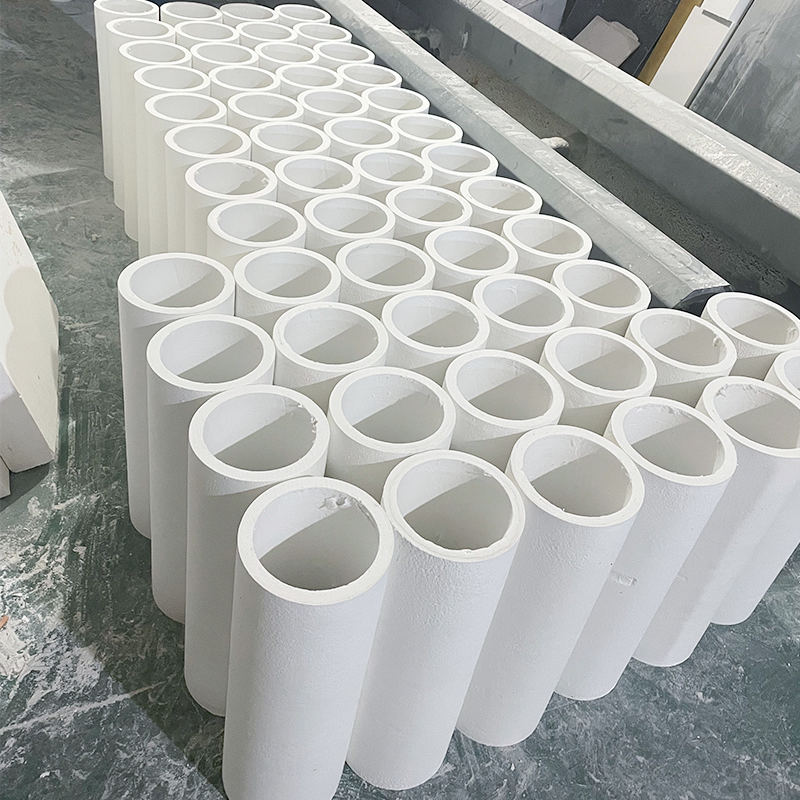
Beyond thermal insulation and mechanical resilience, the rapid heating and cooling response of ceramic fiber tubes directly translates into measurable production gains. Because the tube stores very little heat in its own mass, it reaches target temperature rapidly when the furnace is activated, and cools down quickly during scheduled maintenance windows or between production cycles.
In batch heat treatment operations, this means shorter cycle times, more throughput per shift, and reduced waiting time between loads. Some operators have documented cycle time reductions of 20–40% after replacing dense refractory tube systems with ceramic fiber alternatives. For continuous production environments, the ability to conduct rapid inspections or maintenance without lengthy cool-down periods is a significant operational advantage that impacts annual output capacity.
Choosing the correct grade and specification is essential to realizing the full benefits of ceramic fiber tube technology. Key selection criteria include:
Custom dimensions, bore sizes, and shapes can be CNC-machined from standard ceramic fiber tube stock, making it possible to achieve precise fit in complex furnace geometries without compromising performance. Working with a manufacturer that offers engineering support and free samples before large orders allows for proper validation before full-scale deployment.
The ceramic fiber tube represents one of the most effective tools available to industrial engineers seeking to reduce heat loss, improve energy efficiency, and protect equipment from the damaging effects of rapid temperature cycling. Its combination of low thermal conductivity, outstanding thermal shock resistance, adequate mechanical strength, and rapid thermal response makes it uniquely suited for the demanding conditions found in modern industrial furnaces, kilns, and high-temperature processing systems.
As energy costs and sustainability requirements continue to rise across industries, the case for upgrading to ceramic fiber tube systems becomes increasingly compelling — not just as a performance decision, but as a sound long-term investment in operational efficiency and equipment reliability.
Introduction: Aluminum silicate fiberboard material is currently a high-performance insulation material. Aluminum silicate fiberboard has excellent properties such as light w...
Introduction: Aluminum silicate refractory fiber products are made by selective processing of pyroxene, high-temperature melting, blow molding into fibers, solidification mol...
Introduction: 1、 Shaped ceramic fiber furnace lining for high alumina ceramic fiber board The shaped ceramic fiber furnace lining of high alumina ceramic fiber board mai...

An enterprise integrating design, R&D, production, sales and engineering services. Ceramic Fiber Board Manufacturers, Vacuum Heat Treatment Solutions in China
Phone: +86-13967261180
+86-17858398898
Email: ncjt@zjncjt.com
Arlen@zjncjt.com
Tel: +86-572-8295956
Add: Wulintou, Tangbei Village, Leidian Town, Deqing Country, Huzhou City, Zhejiang Province, China
Copyright © 2024 Zhejiang Nengcheng Crystal Fiber Co., Ltd. All Rights Reserved.

 English
 Español
 عربى
عربى