
E-mail: ncjt@zjncjt.com


Content
A tube furnace works by generating heat from a source outside a cylindrical tube, then transferring that heat through the tube wall to whatever material sits inside — a sample, a workpiece, or a process gas stream. The design keeps heating uniform along the length of the chamber, which is why tube furnaces show up everywhere from university labs running material synthesis to industrial lines doing continuous heat treatment.
What makes the tube geometry useful isn't just the shape — it's that a cylindrical cavity distributes heat more evenly around a sample than a flat chamber does, and it seals easily at both ends for atmosphere control. For anyone comparing configurations, our range of high-temperature tube furnaces for laboratory and industrial use covers horizontal, vertical, and split-tube designs built around this same principle.
Most tube furnaces generate heat one of two ways. Electric resistance heating uses a coiled heating element — commonly an iron-chromium-aluminum alloy wire or silicon carbide rod — wrapped around or embedded near the tube. When current passes through it, the element heats up and radiates that heat inward. This is the standard approach for lab-scale and most industrial tube furnaces because it offers precise, easily automated control.
Combustion-based tube furnaces, used more in heavy industrial settings like hydrocarbon cracking, burn fuel such as natural gas in a radiant chamber to produce a high-temperature flame. The flame heats the outside of the tube directly rather than through a resistance element. Electric designs dominate where temperature precision matters most; combustion designs tend to win where very high continuous throughput is the priority. Furnace heating elements themselves are a wear component — furnace heating elements and spare parts typically need periodic replacement as part of routine maintenance regardless of which heating method a furnace uses.
Once heat is generated, it reaches the material inside the tube through a combination of radiation and convection across the tube wall, then conduction through the wall itself. A thermocouple positioned near the heating zone constantly reads the actual temperature and feeds that signal back to a controller, which adjusts power to the heating element to hold the set point. This closed feedback loop is what lets a tube furnace run programmed heating profiles — ramping to temperature at a set rate, holding (soaking) for a fixed duration, then cooling on schedule — rather than just switching on and drifting.
More advanced systems support multiple independently controlled heating zones along the tube, which matters for processes like chemical transport reactions where different sections of the tube need to sit at different temperatures simultaneously.
The tube itself has to handle both the process temperature and whatever chemical environment is inside it. Quartz tubes are common for general lab use up to around 1000°C, above which quartz begins to devitrify and turn opaque — a known limitation rather than a defect. For higher temperatures or more demanding atmospheres, alumina and mullite tubes take over, offering better high-temperature strength and chemical resistance.
Insulation around the tube matters just as much as the tube material for real-world performance. A poorly insulated furnace loses heat to the surroundings, forcing the heating element to work harder and making temperature control less stable. This is where ceramic fiber insulation materials that improve furnace energy efficiency come in — their low thermal conductivity and low thermal mass mean less energy is wasted heating the furnace structure itself, and the furnace responds faster to programmed temperature changes.
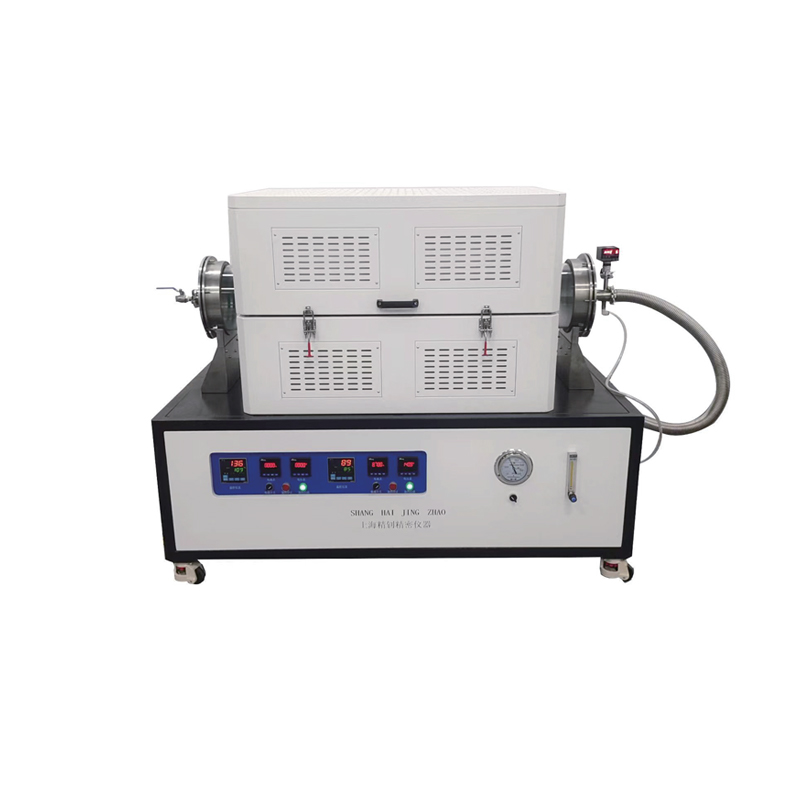
Many tube furnace applications need more than just heat — they need a specific gas environment. End caps with gas inlet and outlet ports seal the tube so operators can introduce inert gas (like argon or nitrogen), a reducing atmosphere (like hydrogen), or an oxidizing atmosphere, depending on the reaction being studied or the process being run. This lets a single furnace support oxidation studies, reduction reactions, sintering under protective gas, and vacuum-assisted processes like carburizing and quenching, simply by changing the gas supply rather than the equipment.
Configuration choice comes down to how the material needs to move and how much temperature uniformity a process demands. Horizontal tube furnaces are the most common choice for samples that need to be loaded and unloaded quickly, sliding a boat or crucible in and out along the tube axis. Vertical configurations are preferred when a process benefits from natural upward heat flow, or when materials need heating from the bottom up.
Split-tube designs, which open along a hinge rather than requiring the whole tube to be removed, make sense for labs handling frequent sample changes where minimizing downtime matters. For processes needing tightly controlled temperature gradients along the tube's length, a multi-zone configuration is usually worth the added cost over a single-zone furnace, since it avoids the temperature drift that happens naturally toward the ends of a long heated chamber.
Introduction: Aluminum silicate fiberboard material is currently a high-performance insulation material. Aluminum silicate fiberboard has excellent properties such as light w...
Introduction: Aluminum silicate refractory fiber products are made by selective processing of pyroxene, high-temperature melting, blow molding into fibers, solidification mol...
Introduction: 1、 Shaped ceramic fiber furnace lining for high alumina ceramic fiber board The shaped ceramic fiber furnace lining of high alumina ceramic fiber board mai...

An enterprise integrating design, R&D, production, sales and engineering services. Ceramic Fiber Board Manufacturers, Vacuum Heat Treatment Solutions in China
Phone: +86-13967261180
+86-17858398898
Email: ncjt@zjncjt.com
Arlen@zjncjt.com
Tel: +86-572-8295956
Add: Wulintou, Tangbei Village, Leidian Town, Deqing Country, Huzhou City, Zhejiang Province, China
Copyright © 2024 Zhejiang Nengcheng Crystal Fiber Co., Ltd. All Rights Reserved.

 English
 Español
 عربى
عربى