
E-mail: ncjt@zjncjt.com


Content
Temperature Uniformity Survey (TUS) is a critical quality control method in the heat treatment industry. It verifies whether the temperature distribution inside a furnace or heat treatment system remains within the acceptable range defined by industrial standards. By measuring temperatures at multiple positions within the furnace workspace, TUS confirms that the thermal environment applied to the processed components is consistent and compliant with technical specifications.
In modern heat treatment operations used in aerospace, automotive, and metal processing industries, accurate temperature control determines the final mechanical properties, dimensional stability, and reliability of components. Standards such as AMS2750H issued by SAE International and CQI-9 published by AIAG define strict requirements for temperature measurement, sensor calibration, and furnace performance verification. These standards require periodic TUS testing to confirm that furnace working zones maintain controlled and uniform temperatures.
Recent technical developments combine industrial temperature data loggers with high-performance thermal insulation enclosures, enabling real-time monitoring while traveling through the furnace process. This “through-process” monitoring approach significantly improves testing efficiency and measurement reliability compared with traditional methods.
The implementation of a Temperature Uniformity Survey depends on furnace design, production mode, and applicable standards. Batch furnaces, continuous furnaces, heating stages, and quenching processes require different testing approaches. TUS methods can generally be divided into traditional survey techniques and modern through-process monitoring systems.
Traditional TUS testing typically uses external field instruments such as chart recorders or static data loggers connected to thermocouples through long trailing cables. Thermocouples are distributed at multiple points in the furnace working zone to capture temperature data during operation.
Uniformity range is defined as the difference between the highest and lowest measured temperature values inside the furnace workspace. While widely used, this method has several operational limitations in modern industrial environments.
In continuous furnaces such as pusher furnaces or conveyor furnaces, trailing thermocouples are vulnerable to electromagnetic interference, mechanical damage, and cable entanglement. The testing process may also interrupt normal production operations, and operators may be exposed to high-temperature hazards.
To overcome the limitations of conventional testing, modern TUS solutions use industrial temperature data loggers enclosed within high-performance thermal barrier systems. The entire monitoring unit travels through the furnace together with the product, allowing direct measurement of real process temperatures.
The system typically includes a multi-channel temperature data logger, thermal insulation enclosure, thermocouples, and dedicated temperature analysis software. For example, a multi-channel logger supporting up to 20 thermocouple channels with ±1.0°C measurement accuracy can simultaneously record temperature data at multiple furnace locations.
During operation, thermocouples attached to test frames or products capture both surface and internal temperature profiles. Wireless narrowband communication technology allows real-time data transmission to external monitoring computers. Even in signal-limited environments such as oil quenching tanks, multi-wireless modules ensure complete data recording.
This monitoring method allows temperature curves to be recorded during heating, soaking, and cooling stages without interrupting production.
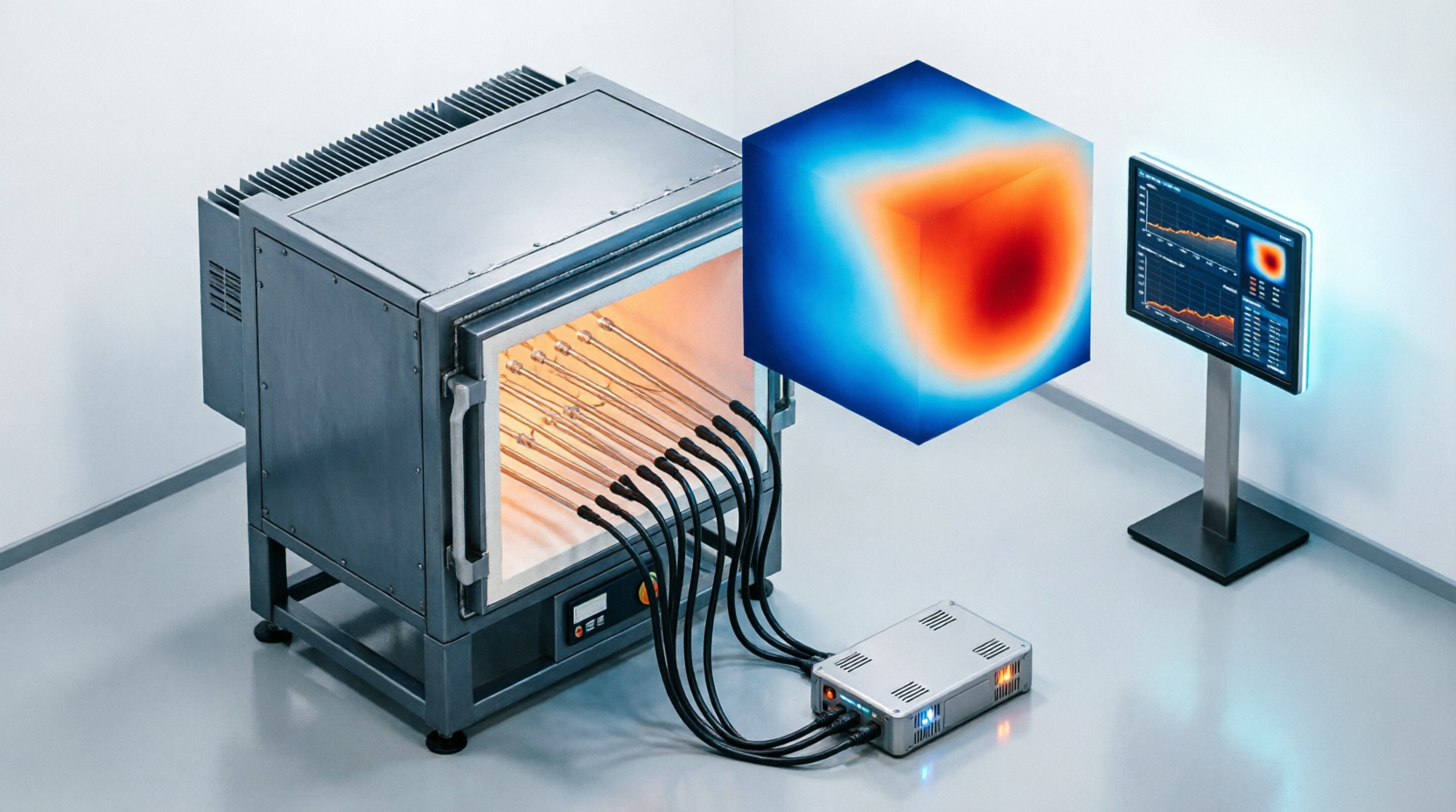
Temperature Uniformity Survey results provide critical process data including temperature deviation, uniformity range, stabilization time, and thermal process curves. These parameters directly influence the microstructure, mechanical properties, and dimensional accuracy of heat-treated components.
Temperature deviation represents the difference between measured furnace temperature and the specified setpoint. Industry standards typically allow deviations within ±5°C to ±10°C depending on the process type.
In aerospace heat treatment operations governed by AMS2750H, excessive temperature deviation can lead to uneven phase transformations. Overheated regions may develop coarse grain structures, reducing fatigue resistance, while underheated areas may retain residual stress that increases crack susceptibility.
The temperature uniformity range defines the difference between maximum and minimum measured values within the furnace working zone. High-precision furnaces classified under AMS2750H Class 1 typically maintain uniformity within ±3°C.
In coating processes, excessive temperature variation may lead to inconsistent coating thickness. High temperature zones may cause premature curing, while lower temperature areas may result in insufficient adhesion.
Statistical analysis has shown that when temperature variation increases by approximately 5°C, hardness variation in heat-treated components may increase by nearly 10 percent. Maintaining stable temperature distribution therefore plays a critical role in achieving consistent product quality.
Temperature curves recorded during TUS testing illustrate the heating, soaking, and cooling stages of the heat treatment process. These curves provide essential information for furnace calibration verification and process optimization.
During quenching operations, cooling curves determine martensitic transformation rates and final material hardness. Uneven cooling may lead to part distortion. Process simulations have shown that optimizing heat transfer coefficients across the furnace environment can reduce dimensional deformation by approximately 30 percent.
Temperature Uniformity Survey plays a critical role in ensuring operational safety, regulatory compliance, and production efficiency in heat treatment facilities.
Heat treatment operations are subject to strict regulatory requirements. Standards such as AMS2750H and CQI-9 require periodic temperature surveys and comprehensive documentation. Aerospace manufacturers and automotive supply chains rely on TUS data during quality audits and certification processes.
Through-process TUS systems allow furnaces to operate under normal loading conditions during testing. This approach reduces downtime associated with traditional surveys and enables continuous production.
Industrial studies estimate that optimized furnace temperature distribution can reduce heating time by 5 percent to 10 percent, resulting in significant energy savings across large heat treatment facilities.
Traditional trailing thermocouple methods may expose operators to high-temperature environments or hazardous quenching media. Through-process monitoring systems isolate personnel from direct furnace interaction, improving operational safety.
Modern TUS systems integrate advanced software analysis, process modeling, and intelligent monitoring tools. These technologies support digital heat treatment management and predictive maintenance strategies within Industry 4.0 frameworks.
Improved temperature control also contributes to environmental sustainability by reducing excessive heating cycles and lowering industrial energy consumption.
Temperature Uniformity Survey has become a fundamental process verification tool in modern heat treatment operations. By measuring furnace temperature distribution, TUS ensures compliance with industry standards, improves product consistency, and supports efficient manufacturing processes.
Advancements in through-process monitoring technologies have significantly improved the accuracy, safety, and efficiency of temperature surveys. As industrial heat treatment continues to adopt digital monitoring and intelligent manufacturing systems, TUS will remain a key technology supporting reliable and sustainable production.
Introduction: Aluminum silicate fiberboard material is currently a high-performance insulation material. Aluminum silicate fiberboard has excellent properties such as light w...
Introduction: Aluminum silicate refractory fiber products are made by selective processing of pyroxene, high-temperature melting, blow molding into fibers, solidification mol...
Introduction: 1、 Shaped ceramic fiber furnace lining for high alumina ceramic fiber board The shaped ceramic fiber furnace lining of high alumina ceramic fiber board mai...

An enterprise integrating design, R&D, production, sales and engineering services. Ceramic Fiber Board Manufacturers, Vacuum Heat Treatment Solutions in China
Phone: +86-13967261180
+86-17858398898
Email: ncjt@zjncjt.com
Arlen@zjncjt.com
Tel: +86-572-8295956
Add: Wulintou, Tangbei Village, Leidian Town, Deqing Country, Huzhou City, Zhejiang Province, China
Copyright © 2024 Zhejiang Nengcheng Crystal Fiber Co., Ltd. All Rights Reserved.

 English
 Español
 عربى
عربى